SpaceX - Powering AI from Orbit, Space Solar, and the Musk Stack (Pt.1)

Opdateret: 29. jun.
SpaceX - Powering AI from Orbit, Space Solar, and the Musk Stack (Pt.1)
Space solar’s ~10× efficiency edge over terrestrial limits — powered by Musk’s self-reinforcing loop of xAI demand, SpaceX launches, and Starship’s killer app.
This article is part 1 in a series of 6. You can find the rest of the articles here:
Summary
Terrestrial solar faces hard physical limits — atmospheric absorption, day-night intermittency, and ~25% peak efficiency — while space solar offers a roughly 10x advantage per watt delivered.
Musk uniquely controls a self-reinforcing loop where xAI needs power, SpaceX needs payloads, and Starship needs a killer app — space-based AI data centers powered by space solar solve all three simultaneously.
Every alternative path carries structural friction — nuclear's decade-long build timelines, natural gas turbine blade shortages, and terrestrial solar's ~4x overbuild plus storage requirement — none of which rivals can resolve as coherently.
The solar cell roadmap progresses from GaAs (proven but too costly to scale) to HJT (current best option at one-tenth the cost) to perovskite/HJT tandems (the ultimate solution, still maturing).
Execution hinges on US-China collaboration for HJT and perovskite expertise and equipment, mirroring how Giga Shanghai rescued Tesla's production crisis in 2019.
The Limits of Terrestrial Solar
Today, natural gas turbine generators are being rapidly deployed to address the energy bottleneck constraining AI infrastructure. However, turbine blade shortages have created multi-year backlogs, capping how quickly new gas capacity can actually come online. In parallel, energy storage systems are being rolled out to capture power during periods of trough demand and excess generation from wind and solar. Peak US electricity capacity stands at roughly 1,000 GW, but typical average utilization hovers around 50%. By building more storage, it effectively doubles usable power consumption in relatively short order.
But if we step back and rethink all energy options from first principles, the picture becomes clearer. Even China — the most aggressive investor in nuclear energy globally — will derive less than 20% of its total electricity from nuclear in the future. The vast majority of China's new electricity supply will come from solar and wind, driven by favorable economics and synergies with desert reclamation efforts. Yet even solar, for all its momentum, faces fundamental physical limits when deployed terrestrially. The atmosphere that protects life also absorbs vast quantities of high-energy radiation, and the rotation of day and night imposes an unavoidable intermittency penalty.
The efficiency gap is stark. On Earth, the practical ceiling for solar panel conversion efficiency is approximately 24.7%, a record achieved by Risen Energy, a leading Chinese solar manufacturer, using high-end heterojunction amorphous silicon (HJT a-Si) technology. The dominant market technology — monocrystalline silicon — typically achieves around 21%. By contrast, gallium arsenide (GaAs) multi-junction solar panels used on satellites in space achieve 30–40% conversion efficiency, the highest attainable with current physics. The trade-off has always been cost: GaAs requires critical rare materials and expensive multi-junction fabrication processes to capture a wider spectrum of light energy.
The Musk Convergence: A 10x Space Solar Advantage
By moving solar panels from Earth to high Earth orbit, the generation side alone delivers roughly a 5x gain in energy output per panel. This compounds three factors: the elimination of the day-night cycle (continuous solar exposure), the removal of atmospheric absorption losses, and the use of multi-junction cell architectures that capture a broader spectrum of radiation. On top of this, because power supply in orbit is continuous, there is no need for the complex terrestrial energy storage systems required to maintain consistent supply through nighttime or persistent cloud cover — eliminating roughly another 2x in system-level cost and infrastructure overhead. Taken together, space solar can be roughly 10x more effective than terrestrial solar on a per-watt-delivered basis.
If China's current solar cost is approximately $0.25 per watt, then excluding launch costs, the effective space solar cost is $0.025 per watt or even lower. The economics are transformative — if the launch problem can be solved.
Interestingly, the pieces of this puzzle now connect into a coherent value chain, much of it running through Musk's companies. SpaceX's Starship launches are methane-fueled, meaning a sustained ramp in launch cadence adds another incremental source of demand for natural gas. While the raw volumes consumed by even an aggressive launch schedule are modest relative to total US gas consumption, the narrative reinforces the structural thesis we laid out in AI Value Chain Bottlenecks: Mapping Pricing Power and Investment Opportunity (Pt.1), where we highlighted US natural gas producers such as EXE, AR, CRK, and EQT as continued beneficiaries of the energy demand-supply gap. Starship simply adds another supportive data point to an already constructive backdrop. More importantly, those launches are what make space-based solar economically viable at scale, and the power harnessed in orbit is precisely what resolves the energy bottleneck facing xAI and the broader universe of AI labs and data center operators. The successful testing and maturation of Starship equipped with Raptor V3 engines is therefore the keystone: it enables the United States to deploy solar in space for AI computing at unprecedented scale, while providing an additional — if secondary — tailwind for the US natural gas complex.
Starship: A Generational Leap
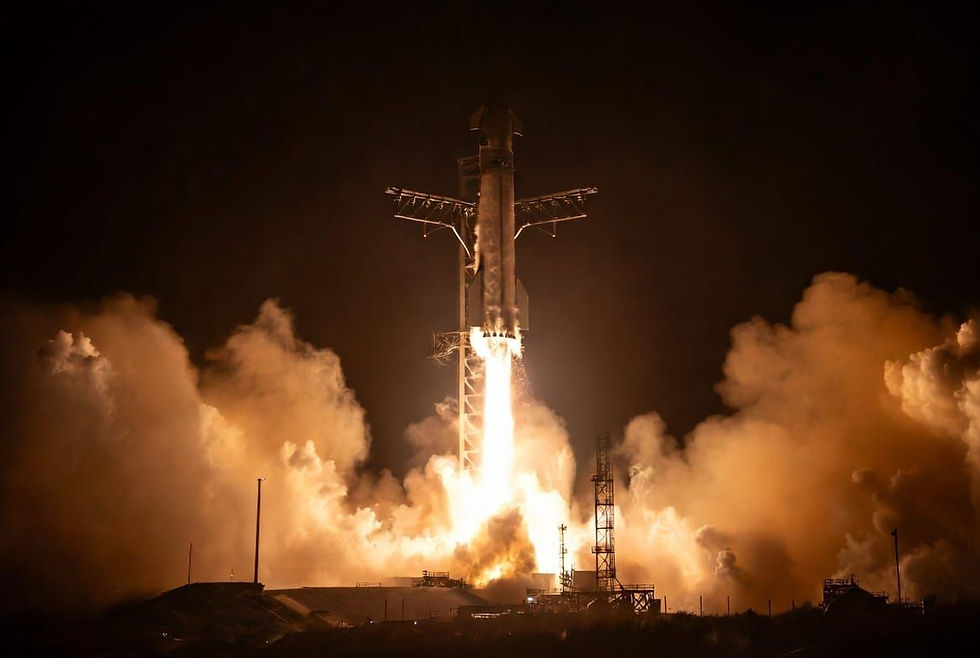
SpaceX has already lowered LEO (low Earth orbit) payload launch costs from over $25,000/kg to approximately $2,500/kg via Falcon 9. The Falcon 9 architecture involves a reusable first-stage booster — the main engine section that provides initial lift-off thrust — and a recoverable payload fairing, the protective nose cone that shields the cargo during ascent. Together, these account for the bulk of per-launch cost, and productionizing their reuse is what drove the order-of-magnitude reduction. Starship represents another such leap: both the first stage and the second stage (the upper vehicle that carries the payload into orbit after booster separation) are now fully reusable, powered by the Raptor engine — the first full-flow staged combustion (FFSC) cycle engine ever built.
In an FFSC design, 100% of the fuel and 100% of the oxidizer are pre-burned in separate, dedicated turbopumps before entering the main combustion chamber. This maximizes efficiency by feeding only gas-phase propellants into the chamber and, due to lower turbine operating temperatures, enables higher thrust, greater reliability, and full reusability.
Starship is the most efficient and performant rocket humanity has ever built, with 200+ tons of LEO payload capacity targeting costs below $100/kg. For context, China's total tonnage shipped to space in 2025 was approximately 300 tons, while global shipments totaled 3,000 tons — of which SpaceX delivered 2,500 tons, including 2,100 tons of Starlink satellites alone.
The Killer App Problem
The irony is that Starship is so powerful that without a compelling use case, it risks being economically unjustified — remarkable technology without sufficient demand to achieve economic justification. SpaceX faced this exact problem after Falcon 9's success. The solution was Starlink: a constellation eventually comprising 30,000 satellites at 550 km altitude, offering connectivity via phased arrays to anyone on Earth with a Starlink terminal. The latest Starlink V3 will feature direct-to-cell phone connectivity, and direct-to-cell via satellite will likely become part of the 6G standard.
In 2025, Starlink satellites accounted for approximately 70% of all satellites launched globally. One Falcon 9 launch carries about 25 Starlink satellites; one Starship can carry ~500. If Starship is a great success, SpaceX will soon run out of things to launch into space — even with Starlink's massive 30,000-satellite constellation. It is as though the iPhone has been created, but the App Store and killer apps like Uber have yet to emerge and prove the platform's full value.
Now, it feels imminent that the killer app for Starship is space-based AI data centers powered by space solar — the most optimal technical route available. And because this route is led by a single leader, Elon Musk, across multiple vertically integrated companies, it is progressing far more rapidly and coherently than alternative paths such as nuclear, wind, natural gas turbines, or other terrestrial options.
Gas Today, Space Solar Tomorrow
It bears noting that xAI recently ordered another five gas turbine generators at 380 MW each from Doosan Enerbility, a South Korean company. Natural gas is currently the only viable path for Western AI data centers to secure sufficient power supply on the required timelines. Demand is so intense that buyers are exhausting production capacity from tier-one turbine suppliers and sourcing from less established but production-ready vendors in South Korea and China.
But can we realistically run 100 GW, 1 TW, or 10 TW of AI infrastructure entirely on natural gas? Obviously not. Nuclear is the other commonly cited answer, but it carries enormous technical execution and production ramp-up uncertainty. Space solar, by contrast, requires no fundamental scientific breakthroughs — the underlying physics is well understood, and the remaining challenges (radiation hardening, wireless power transmission, in-orbit assembly) are engineering and production problems rather than scientific research problems. What it demands is brutal, singular focus on manufacturing and launch cadence — the kind of execution Musk's vertical stack is uniquely positioned to deliver.
The China Factor: Why SpaceX Needs China
Ironically, space solar is made possible by the collaboration of the world's two superpowers — the United States and China. Elon Musk is arguably the only figure who can simultaneously drive industrialization in the US while maintaining productive relationships between these tense competitors.
The Tesla Precedent
Recall that Tesla was the most heavily debated short thesis on Wall Street in 2017. The Model 3 was a great success in product terms — an exceptional vehicle that accumulated a massive order book. However, converting those orders into revenue required a production ramp that became a nightmare. The problem is one that plagues any American company attempting high-volume mass production of highly industrialized goods domestically: the upfront capital expenditure required to build a production line is roughly 5x the annual revenue that line will generate once operational. In other words, a factory producing $1 billion of cars per year might cost $5 billion to build. For a company in parabolic growth, this ratio is brutal — the faster your order book expands, the more aggressively your CAPEX burns ahead of the revenue needed to fund it.
What makes this dynamic even more treacherous is execution risk — there's no guarantee that the capital committed actually translates into a functioning production line on time, on budget, and at quality. During TSLA's parabolic growth phase from 2017 to 2019, this combination of cash burn and execution uncertainty left Tesla treading water. Wall Street sharks smelled blood — shorting the company not on product or vision, but on financial vulnerability.
The turning point came from China. In May 2018, the Chinese government approved Tesla to establish a wholly owned subsidiary — the first time China had allowed a foreign carmaker to bypass the traditional 49/51% joint venture requirement. Tesla's Giga Shanghai broke ground on January 7, 2019, and began delivering China-made Model 3 vehicles to customers on December 30, 2019 — under one year from construction to delivery, setting a record. This was largely thanks to the support of Shanghai's mayor Li Qiang, who later became Premier on the strength of his economic development record. The rapid production ramp at low cost and high quality pulled Tesla out of the ICU and ignited the massive share price gains of early 2020. The executive who led the buildout and operation of Tesla China was Tom Zhu, who now serves as Elon Musk's right hand at Tesla, overseeing global manufacturing.
The SpaceX Parallel
Now, SpaceX needs China for the same reason Tesla did: to solve a production scaling problem that the US industrial base cannot address alone.
In February 2026, Elon Musk swiftly announced the merger of SpaceX and X.ai — SpaceX valued at $1 trillion, X.ai at $250 billion. Musk previously held approximately 40% of SpaceX and 70–80% of X.ai; the combined entity gives him a 50%+ stake and complete control. The merger happened within weeks of Musk publicly lamenting on X the regulatory barriers limiting X.ai's data center buildout beyond 1 GW. If 1 GW is already extraordinarily difficult to achieve on Earth, then 10 GW and 100 GW are near-impossible within any reasonable timeline. X.ai has the energy demand; SpaceX has the Starship supply ready to be utilized.
The Core Cost Problem
The biggest question is whether the cost of space solar can approach or even undercut terrestrial alternatives.
Currently, space solar costs roughly $2–3/kWh, while terrestrial solar costs $0.03–0.05/kWh. The core issue is twofold: traditional gallium arsenide (GaAs) solar panels used in space are prohibitively expensive, while traditional monocrystalline silicon panels used on Earth are too heavy for economical orbital deployment.
Closing this gap — beyond continually lowering Starship launch costs — requires solar panels that are simultaneously more efficient, lighter, and rollable. The leading candidate architecture is a perovskite-based HJT tandem cell on an ultra-thin glass (UTG) substrate. In short: HJT (heterojunction) is a high-efficiency silicon cell design, perovskite is a thin-film material that absorbs a different part of the solar spectrum, and stacking the two in a tandem configuration captures more energy than either layer alone. UTG replaces the heavy glass used in conventional panels, dramatically reducing mass per watt — the single most important metric for anything destined for orbit.
If this combination can be deployed at scale and rolled into dense columns inside Starship's payload bay, space solar has genuine potential to match or beat terrestrial solar economics. However, both HJT and perovskite technologies still have a long road of maturation ahead.
Technology Roadmap for Space Photovoltaics
1. Gallium Arsenide (GaAs) — The Current King of Aerospace
GaAs solar cells are manufactured as multi-junction stacked structures. The most common configuration — the triple-junction design — uses an InGaP/InGaAs/Germanium stack on a germanium substrate. The top junction (indium gallium phosphide) absorbs high-energy blue-violet light. The middle junction (gallium arsenide) absorbs medium-energy visible light. The bottom junction (germanium) absorbs low-energy infrared light.
This spectral-splitting approach allows triple-junction cells to achieve real-world conversion efficiencies of 30–32% (with a theoretical ceiling above 50%), compared to single-junction silicon cells which top out at around 26–27% in practice (theoretical limit ~33%). Adding further junctions pushes efficiency higher still — research-grade four- and five-junction cells have exceeded 47% in laboratory conditions — but at rapidly escalating cost. The cells themselves are impressively thin — just 50–80 micrometers — which provides good foldability.
Triple-junction GaAs is currently the most cost-effective solution in commercial mass production for space applications, with the technology matured and validated in orbit over decades. Beyond raw efficiency, multi-junction designs also degrade more gracefully under prolonged radiation exposure, which matters enormously for satellites expected to operate for 10–15 years in orbit. The major drawback is cost: reliance on rare elements such as gallium, indium, and germanium makes it difficult to scale production to support constellations of tens of thousands of satellites.
SpaceX is now shifting attention toward cheaper heterojunction technology better suited for large-scale manufacturing. If triple-junction GaAs is abandoned by the space computing industry, it will lose the only large-scale application capable of sustaining its market.
2. Heterojunction (HJT) — The Current Optimal Solution
Heterojunction technology deposits amorphous silicon thin films onto crystalline silicon wafers, combining the advantages of monocrystalline silicon and thin-film cells. It achieves conversion efficiencies of 25–26%, has a low temperature coefficient (meaning better performance under intense sunlight), and can be manufactured on ultra-thin silicon wafers below 100 micrometers. When paired with flexible packaging, the cells offer excellent foldability (allowing panels to be folded or rolled tightly for launch, then deployed in orbit). Most critically, the cost is less than one-tenth that of GaAs.
Although HJT's radiation resistance and conversion efficiency are slightly inferior to GaAs, its cost advantage makes it widely regarded as the best current solution for large-scale commercial satellite deployment — and a highly cost-effective transitional technology, with the ultimate solution being perovskite (discussed next).
HJT is at a critical juncture, transitioning from experimental validation to scaled commercial application. In tests simulating 5–7 years of radiation exposure in low Earth orbit, power retention rates have reached 85% or above.
Driven by deployment cost, SpaceX is switching to HJT cells on a large scale for its V3-generation Starlink constellation and planned space computing centers. Among Chinese HJT manufacturers, Risen Energy and Maxwell are currently considered the most likely to hold actual SpaceX orders.
3. Perovskite — The Future Disruptor
Perovskite is a novel artificially synthesized crystalline material manufactured through solution coating methods. The current research focus is on perovskite/HJT dual-junction tandem cells — a perovskite top layer paired with an HJT silicon bottom layer.
This approach leverages HJT's mature supply chain alongside perovskite's high efficiency. Conversion efficiency exceeds 30%. The tandem stack is extremely thin at 50–100 micrometers, offering outstanding foldability. The theoretical energy-to-mass ratio is 50–100x higher than triple-junction GaAs. Perovskite also possesses a remarkable ability to self-repair from proton damage (caused by high-energy protons in the space radiation that constantly bombards satellites, which disrupt the cell's crystal structure). Production costs are extremely low, with a manufacturing process akin to printing. For all these reasons, perovskite is considered the ultimate solution for large-scale space computing.
However, the technology is not yet mature. Lifespan under vacuum and high-temperature cycling conditions remains unverified. It is currently in a critical phase of in-orbit validation, with testing lasting approximately one year so far. It is a key technology being closely evaluated by SpaceX and other commercial aerospace companies.
Progress and Path Forward
No one will use current GaAs for mass-scale space solar — the economics simply do not work. But HJT is not yet mature either. From domain experts, we understand that currently only two Chinese companies can produce HJT at commercial scale: Risen Energy (publicly traded) and Huasun (private). Other Chinese vendors remain in the lab research phase.
A major bottleneck for HJT is durability. Early prototypes showed promising initial results but exhibited fast decay in conversion efficiency after the first year. This decay will likely accelerate under direct space exposure, where various forms of radiation damage cell microstructures. However, this is fundamentally an engineering problem, not a scientific one. For Chinese vendors with ample capital and labor, it is a matter of when, not whether, they solve it.
Recently, it was reported that Elon Musk's teams — likely from both Tesla and SpaceX independently — are visiting Chinese vendors on-site for technical evaluations. The exact details remain unclear, but HJT-ready providers are evidently at the top of the priority list. Due to ITAR (International Traffic in Arms Regulations), SpaceX components must meet military-grade safety standards and be clear of adversary-nation influence, making it difficult for SpaceX to source finished solar panels directly from Chinese vendors.
The more likely path is that Tesla and SpaceX will prioritize building domestic solar panel factories using fabrication equipment imported from China. This creates an ironic symmetry: China builds cutting-edge chip fabs relying on Western leading-edge wafer fabrication equipment (CVD, lithography), while the US builds cutting-edge solar panel factories relying on Chinese leading-edge fabrication equipment. The most probable core equipment suppliers include Suzhou Maxwell and Shenzhen S.C New Energy Technology, with Laplace and Autowell as secondary candidates.
Beyond equipment, because the US has been detached from mainstream silicon-based solar panel production for decades — with most patents and research around HJT and perovskite controlled by Chinese entities — Musk's companies will likely pursue technology licensing deals, joint ventures, or other partnership structures to bring Chinese solar cell expertise into US factories and mature HJT and perovskite technology on an accelerated timeline. The fallback: if these arrangements prove too difficult to execute, they will import raw goods or components from China directly and assemble finished panels domestically — which SpaceX has already been doing for years.
We want to stress: the question is not whether this can work, but when and how. SpaceX's space solar and space AI DC initiatives face few technology-level hurdles — the challenges are political and commercial. Notably, this is exactly what slowed Starship's progress. SpaceX could have achieved successful Starship launches several quarters earlier, but regulatory obstacles under the Biden administration delayed testing flights for multiple years.
For context, the US currently produces less than 4 GW of silicon-based solar per year. The majority of domestic solar output comes from First Solar's cadmium telluride thin-film panels (14+ GW capacity) — a less efficient but cheaper and easier-to-manufacture technology. Total US solar system deployment runs at approximately 50 GW annually, but core components rely on imports. The key bottlenecks — know-how, labor costs, and supply chain support — will require collaboration with Chinese vendors to overcome.
China has driven solar costs down by 5x over the past decade through full-stack efficiency and quality gains spanning raw silicon materials, wafers, and cells. This cost advantage will only be amplified as solar energy becomes the most critical power source for both AI and humanity's long-term future.
This is marketing material for NewDeal Invest. The investment style is aimed at investors with a high risk profile and a long-term investment horizon, and past performance is no guarantee of future returns. The stocks that NewDeal Invest invests in are more volatile than the broader stock market, and therefore fluctuate more both up and down. NewDeal Invest does not provide investment advice, and all investment decisions are made by you yourself. No information from NewDeal Invest should be considered a recommendation. Short-term investments, with a time horizon of 5 years or less, are discouraged both in NewDeal Invest, PMINDI, and in the stocks mentioned. See relevant risk factors at https://newdealinvest.dk/ and https://newdealinvest.dk/pmindi/

Kommentarer