SpaceX - Powering AI from Orbit: Sizing the Opportunity (Pt.6)

Opdateret: 29. jun.
SpaceX - Powering AI from Orbit: Sizing the Opportunity (Pt.6)
SPCX is now the ultimate AI data-center and energy play. At ~$2.4T and ~80x forward sales, its valuation rests almost entirely on Space Data Center execution — where Starship, solar, and custom silicon could unlock a path toward $20T.
This article is part 6 in a series of 6. You can find the rest of the articles here:
Summary
Now publicly listed after its record June 2026 IPO, SPCX is best understood not as a launch company but as a vertically integrated space-and-AI infrastructure platform, with its ~$2.4T market cap and ~80x forward P/S reflecting conviction in optionality far beyond today's core operations.
The 2025 financials reveal a business already throwing off substantial cash—$18.7B revenue and $6.6B adjusted EBITDA—where Starlink (61% of revenue) funds operations, meaning the IPO's $75B raise was strategic "dry powder" for AI capex rather than a survival necessity despite the $4.9B GAAP loss.
The entire bull case—and the gap between the $1.75T IPO valuation and any path toward Musk's $20T target—rests almost entirely on Space Data Center execution, where each deployed gigawatt is modeled to add roughly $50B in market cap (or $64B with custom silicon).
SPCX's structural edge is bottleneck arbitrage: while terrestrial AI faces binding constraints in power, regulation, and chips, orbital solar offers near-unlimited energy with no regulatory friction, positioning the company to monetize scarcity through deals like the $75B Google and Anthropic compute contracts.
The valuation range is extraordinarily wide and binary—the base case implies ~$2,963/share (~19x upside) on 60 GW solar capacity and the bear case still ~$608/share (3x)—but every scenario hinges on the unproven trio of reusable Starship, mass-scale solar, and in-house AI ASICs landing roughly on schedule.
SpaceX Fundamentals
With SPCX now successfully listed on Nasdaq following its record June 2026 IPO, investors have access to clean, audited financials for the post-merger consolidated entity that includes SpaceX’s core launch and satellite operations, X, and xAI.
In 2025, SPCX generated $18.7 billion in total revenue, up 33% from approximately $14 billion in 2024. Starlink (the connectivity segment) was the clear standout, contributing $11.4 billion or 61% of revenue and acting as the primary profit engine. The company delivered a healthy $6.6 billion in adjusted EBITDA; however, aggressive capital expenditures — particularly in AI infrastructure, Starship development, and orbital initiatives — produced a GAAP net loss of $4.9 billion.
At a current market capitalization of approximately $2.4 trillion against an estimated $30 billion in NTM revenue (linearly interpolated from analyst FY2026 and FY2027 projections, with the bulk of near-term growth expected from Starlink), SPCX trades at an implied forward P/S ratio of ~80x. While elevated, the multiple reflects strong conviction in sustained high growth across satellite broadband, launch services, and emerging AI/orbital compute opportunities. Unlike many high-multiple growth companies, the core business is already generating substantial adjusted profits, meaning the IPO was not required to fund ongoing operations — its primary purpose is to provide dry powder for the substantial capex ahead.
Revenue breaks down across three segments: Starlink (Connectivity) at approximately $11.4 billion (61%), the Space Division (Launch Services) at roughly $4.1 billion (22%), and the AI Business at roughly $3.2 billion (17%). The AI segment includes compute infrastructure and AI-related subscription revenue from xAI’s core operations, together with advertising and subscription revenue from the X platform — all consolidated following the February 2026 combination. It is also the most capital-intensive segment, absorbing roughly $12.7 billion in capex for the year.
As noted above, SPCX had no need to go public prior to the combination with X and xAI: the business was FCF positive, and Starlink’s continued rollout should only expand FCF margins from here. The primary driver for accelerating the IPO timeline — and raising $75 billion immediately — was the acute cash burn associated with AI data-center capex. That burden becomes especially large once launch and satellite costs are layered on top of the dominant silicon and power-related spend.
Before we dive in, it is worth noting how profitable the terrestrial AI data center (TDC) business already is. When xAI was founded, Elon Musk used the same playbook he has employed elsewhere — leading with a headline-grabbing infrastructure target. For xAI, that meant building the largest 100k-H100 cluster, followed by the largest GPU clusters powered by GB200 and GB300. xAI’s infrastructure team has executed exceptionally well, bringing clusters online faster than peers (including the first 60k H100s in roughly 120 days). Model-training progress has been slower by comparison. Grok models now sit firmly in the tier-1 cohort but remain a step behind the tier-0 frontier set by leaders such as Mythos. A meaningful portion of this gap appears linked to xAI’s high-pressure, rapid-iteration environment — an approach that has delivered extraordinary hardware results at Tesla and SpaceX but can be less optimal for frontier AI research, where many top researchers appear to prefer the more deliberate, focused cultures seen at labs such as Anthropic.
ROI of the AI Terrestrial Data Center (TDC)
Before turning to Space DC, it is worth examining the current economics of the terrestrial AI data center (TDC) business. In 2025, SPCX invested $12.7 billion in AI data center capex. In Q1 2026 alone the figure reached $7.7 billion — implying a $30.9 billion annualized run rate. On a standalone basis, relying primarily on Grok API and consumer revenue, the business would likely post substantial losses this year until Grok 5 and subsequent models scale.
Grok 4 remains a strong model but is currently state-of-the-art only within the ~500B-parameter class. By comparison, several mainstream competitors have already moved well beyond this scale: China’s Kimi and DeepSeek operate in the 1T+ range, Opus-class models sit around 5T parameters, and Mythos exceeds 10T. xAI is now developing 1T+ and 5T+ models. We expect Grok 5 to deliver at least competitive base performance, although this is unlikely before late this year as the model-training organization resets following the recent xAI reorg (which saw the departure of all founding researchers).
While SPCX has aggressively front-loaded AI data center capacity — building faster than its own model training roadmap could immediately absorb — many hyperscalers and frontier AI labs significantly underbuilt their compute infrastructure. This mismatch has created periods of excess capacity at SPCX that Musk has moved quickly to monetize through major deals with Google and Anthropic, both of which now face acute shortages.
Anthropic’s revenue has grown explosively, from $9 billion ARR at the start of the year to $40 billion in Q1 2026. Google, meanwhile, badly underplanned its capacity: its infrastructure arm sold 2 million TPUs to Anthropic last year before Google’s own AI teams realized they lacked sufficient internal compute. With Gemini now at 9 million MAU, Google faces a serious compute shortage of its own.
It is therefore no surprise that both Google and Anthropic signed three-year deals with SPCX, worth $30 billion and $45 billion respectively. That represents $75 billion in contracted three-year revenue against roughly $20 billion in associated capex — equivalent to $2.15 billion per month ($900 million from one deal and $1.25 billion from the other), or $25.8 billion per year. These economics are attractive even by AI infrastructure standards. Other players have already posted 30%+ ROIC on AI capex, and the Convequity AI Bubble Barometer currently shows hyperscalers generating forward ROIC on AI capex of approximately 32% (barometer.convequity.com). The high returns may persist longer than many expect: H100 hourly rental rates have spiked again this year, which is remarkable for a three-year-old chip.
The root cause is an industry-wide bottleneck of varying severity:
TSMC is limiting logic-node capacity expansion and CoWoS advanced-packaging expansion — a mild bottleneck.
SK Hynix, Samsung, Micron, and others are limiting DRAM, HBM, and NAND capacity expansion — a growing and large bottleneck.
Lumentum (LITE), Broadcom (AVGO), and others have been slow to meet EML and InP CW laser demand — a large bottleneck.
Most importantly, power supply to AI data centers is now the single biggest constraint: 40 of 100 AI data-center projects have been cancelled for lack of secured power.
Currently, the TDC business faces several issues, ranked by severity. Building the data-center shell is a relatively minor one. Lead times for power equipment and non-IT hardware represent a larger challenge, but still not the most significant. The biggest hurdle is regulatory friction: many local governments and entities oppose further TDC buildout in their jurisdictions, and overcoming this requires substantial political effort. Beyond regulatory issues, access to reliable power is the binding constraint. Natural-gas turbine generation cannot effectively serve power demand scaling toward 10 GW and eventually 100 GW. Ground-based solar can technically meet this need — the U.S. could solve much of it simply by importing panels from China — but tariffs and trade barriers stand in the way. This is precisely why Space DC (SDC) is becoming an increasingly attractive bottleneck-solver: space offers no regulatory friction, and payload costs are falling rapidly.
Space DC Economics
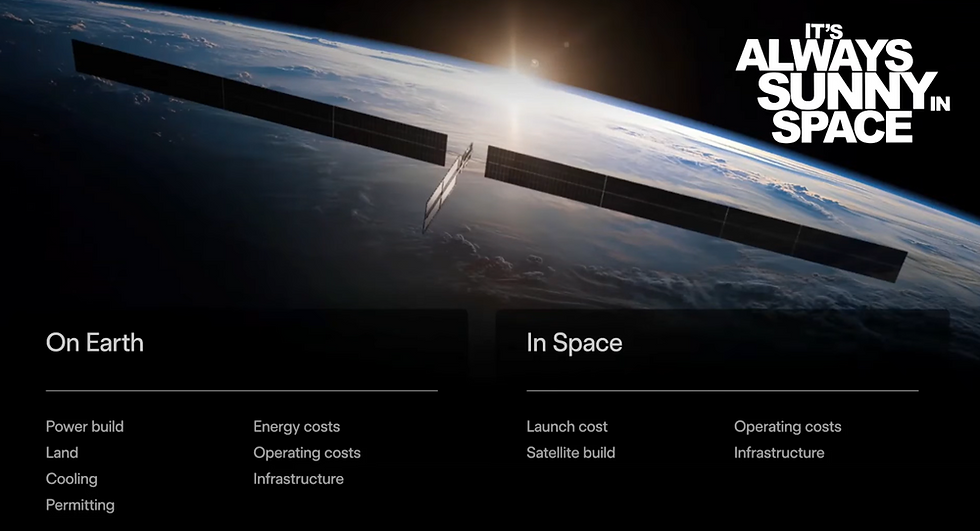
In the ideal case of a fully reusable Starship V3, the launch-cost math is straightforward: 100 GW requires roughly 10,000 Starship launches at ~$5 million each, totaling $50 billion. That works out to $500 million per GW for launch. Assuming aggressive future panel costs of $0.20/W (achievable with mature, high-efficiency solar technology such as HJT at mass scale), solar generation adds roughly $200 million per GW.
We model the first-generation AI satellite (AI1) as built on a Starlink V3 chassis. It generates 150 kW and supports an NVL72-like rack design. A full Starlink V3 satellite costs $1–1.2 million. While AI1 can avoid Starlink’s full user-facing phased arrays and heavy inter-satellite laser payload, it will still require lighter optical communications for inter-satellite coordination and ground connectivity. As a result, we estimate its non-rack components (structure, power systems, and basic bus) at roughly $500–700k per satellite — meaningfully lower than a full Starlink satellite but not assuming a complete elimination of optical links.
To calculate the non-AI-chip cost per GW:
1,000 MW / 0.15 MW per satellite = 6,667 satellites per GW
Using the lower end of the range ($500k per satellite):
6,667 * $500k = $3.3B per GW (non-AI chip cost)
These figures — launch, solar generation, and satellite platform — look remarkably cheap against roughly $20 billion per GW in total terrestrial non-IT data-center costs, plus more than $1 billion in annual opex.
Below is a conservative cost estimate based on near-term technology assumptions:
Power density of 70 kW per ton for the AI1 satellite
Merchant GPU rack priced at $4M, with 150 kW peak load and 120 kW normal load
Approximately $3 billion per GW in non-rack costs (solar, structure, and supporting systems), as AI1 has not yet adopted efficient HJT (Heterojunction Technology) solar cells at mass scale
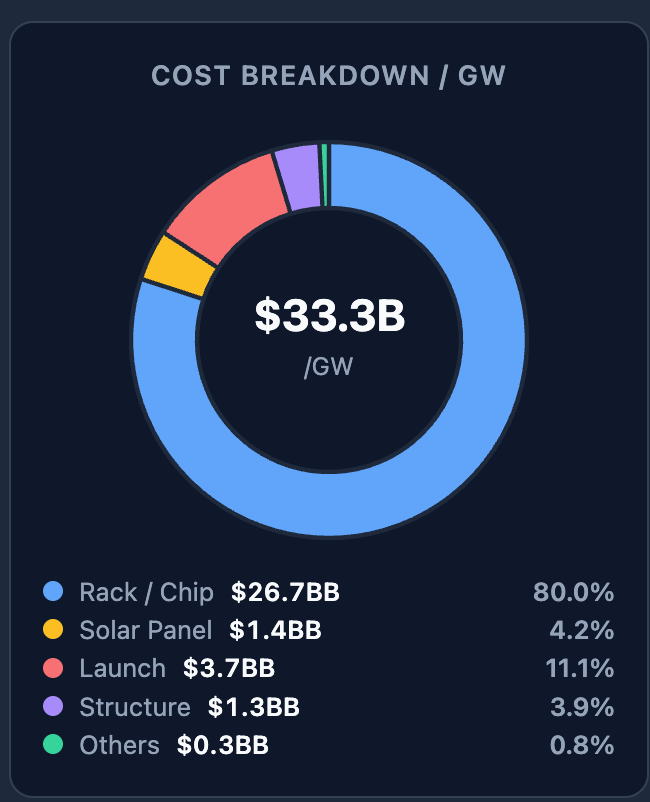
Under these conservative assumptions, IT hardware (chips and racks) rises to 80% of total cost per GW — materially higher than the roughly 60% share typically seen in terrestrial data centers. Reducing this dominant cost component will require moving beyond merchant GPUs, which NVIDIA currently sells at 75–80% gross margins, toward custom silicon.
If Tesla delivers AI chips for space on schedule, per-ASIC costs could fall to roughly $10,000 per kW, translating to $10 billion per GW in chip costs. That would roughly halve the total cost per GW, to $16.5 billion.

To cut chip costs further, building your own fab becomes necessary — not only because NVIDIA continues to extract high gross margins, but because memory makers have also reached ~80% gross margins on HBM. Memory has now become the largest cost component in high-end AI accelerators.
A single Rubin-class GPU carries 288 GB of HBM4. At $55/GB, that equates to $15,840 in memory cost alone — far exceeding the $1,500–2,000 cost of the compute dies on a 2.3 kW chip. Memory makers’ deliberate restraint on capacity expansion is likely to keep HBM pricing elevated.
Vertical integration into memory and logic production could therefore deliver substantial cost reduction. In-house manufacturing could potentially bring memory cost down to around $2,000 per 2.3 kW GPU and logic die cost below $1,000, resulting in a fully integrated AI ASIC costing as little as $3,000–4,000 per chip (excluding tape-out, design, and IP costs).
The cost breakdown of NVDA racks below further illustrates the importance of cutting down the memory chip cost. The memory cost shot up by 4x in just one generation and if we continue to build longer context running agents, the demand will only grow more. Likewise, a large part of the ~$4m GPU cost in VR200 is for HBM4 memory that has risen dramatically as well.

If we conservatively assume a custom fab halves the chip cost, chip costs fall to $5 billion per GW and total 1 GW cost drops to $11.6 billion.

In March 2026, Tesla launched the TerraFabs project to build its own chip-fabrication capacity. The speed is unsurprising: at 100 GW+ per year, the project would absorb a very large share of global new logic, memory, and advanced-packaging capacity. Details remain scarce, but early information suggests TerraFabs will comprise 10 fabs located north of the Texas Gigafactory. The initial Fab 1 is targeting 2nm process technology with a capacity of 100,000 wafers per month.
Rumors suggest Musk is exploring novel approaches to ease bottlenecks, including square 450mm (18-inch) wafers, microenvironment isolation instead of traditional cleanrooms, and higher-power, more efficient EUV tools. Tesla will likely source IP and process licenses from Intel and Samsung — both of which have strong incentives to participate, given that this represents $100 billion+ in capex that neither can easily fund alone.
Notably, Fab 1’s planned capacity implies very large compute output. At 100,000 wafers per month (1.2 million wafers per year) and assuming 80 dies per wafer, the fab would produce approximately 96 million dies annually. At 1,000 W per die, this equates to roughly 96 GW of AI compute capacity per year — closely aligning with Tesla’s stated goal of supporting a ~100 GW annual launch cadence.
Owning leading-edge logic capacity would allow Musk to capture TSMC’s substantial gross margin (typically 50–60%), which represents a meaningful cost opportunity. However, because TSMC has historically been a relatively disciplined and customer-friendly supplier — with price increases usually in the ~15% range rather than the aggressive hikes seen in memory — the incremental savings from avoiding its margin may be more moderate than they first appear.
More importantly, TSMC has been cautious on capacity expansion precisely because its margins, while healthy, are not as outsized as those of memory makers. This restraint creates allocation risk during periods of strong demand. TerraFabs’ logic-node investment is therefore driven primarily by the need to secure reliable wafer supply and bypass TSMC’s allocation queue, rather than by the expectation of dramatic cost reduction alone. In Musk’s assessment, TSMC is unlikely to ramp capacity fast enough to meet AI-driven demand, raising the prospect of severe bottlenecks within three to four years.
On execution: 450mm square wafers are very unlikely to reach production soon, because every piece of WFE is designed for circular 300mm (12-inch) wafers, and a new standard requires an industry-wide overhaul. Ramping capacity within two years — before HJT and Starship are ready — is an extremely tight timeline. Compared with solar-cell scaling, semiconductor scaling is far harder, involving many more vendors and countries.
TerraFabs' stated target is 1 TW of annual production — more than all existing fabs combined, and far above industry consensus for total global chip output in 2030. The plan envisions 80% of chips deployed in space and only 20% on the ground, at 1M wafers per month. The global chip market grew from $300 billion to $600 billion over the past decade, a ~7% CAGR; Musk effectively wants to double the existing market. A single leading-edge fab costs ~$20 billion, so the full TerraFabs plan could run into the trillions. This is typical of Musk's approach of setting huge targets, that if are only partially achieved, can still deliver tremendous value.
The first workhorse product TerraFabs will produce is AI5, an inference chip designed entirely in-house at Tesla — from architecture to circuit diagrams. Its specs are striking: versus the prior-generation AI4, it delivers 40–50x faster performance and 9x more memory. The dual-chip configuration's inference performance is roughly in the NVIDIA B100/B200 range, but at about 10x lower inference cost and roughly 3x higher performance per watt. At the launch, Musk said, "It's a beautiful chip — I poured too much into it," then paused for several seconds without saying anything more.
The chip itself is not where TerraFabs is most aggressive. What Musk really wants to upend is the industry's decades-old division of labor: fabless firms design the layout, send it to TSMC for fabrication, then ship to OSAT for packaging and test — a cycle often measured in quarters. A single photomask adjustment, from sample delivery to verification, can take months. TerraFabs aims to compress that chain into a single building over days: lithography mask-making → wafer production → chip testing → next mask, iterating like a rocket. Musk has done this once already at SpaceX, where the "fail fast, fix fast" loop drove Falcon reliability from 60% to 99%. He wants to do it again on silicon.
On packaging, TerraFabs chose FOPLP (fan-out panel-level packaging), replacing the 300mm wafer with a 600×600mm panel to package more chips at once, with a fundamentally different cost structure. Samsung and Japanese panel makers have done this; its maturity trails EUV-mainstream packaging, but if yield holds, the cost advantage is real.
An ASML High-NA EUV system costs about $380 million with a lead time exceeding two years — order today, and you may not get one before 2028. A 1M-wafers-per-month target implies dozens of these machines. This kind of climb took TSMC 30 years and Samsung 20 years.
As expected, Musk chose to source the logic-node IP from an established TSMC competitor: Intel. Intel wants to expand capacity massively to make its foundry model work but is short on cash and is running low on funds to finance future process-node development. Partnering with Tesla and SPCX makes perfect sense: Intel offloads cash burn, secures a large customer, and co-evolves its foundry and process node. One likely reason Musk passed on Samsung is that he has already secured large cutting-edge-node capacity there at essentially below-COGS pricing — Samsung effectively begged for the order to keep its low-yield leading-edge node loaded. That node finds few customers because yields are so poor that even at rock-bottom prices, TSMC remains the better ROI. Only large customers like Tesla can anchor such an order, alongside smaller AI-ASIC startups like Tenstorrent and some Bitcoin-ASIC miners.
Memory-making capability is trickier. Samsung has little incentive to license out a money-printing machine, and a cash-constrained memory maker willing to license is hard to find. China's YMTC and CXMT are the only real exceptions, but it is highly unlikely that either China or the U.S. would permit them to license technology to Musk and co-build fabs. NAND may be easier, since YMTC has already licensed its hybrid-bonding Xtacking technology to Samsung, but DRAM is far harder: core patents are controlled by Samsung, SK Hynix, and Micron, and it took CXMT a decade to evolve the bankrupt Qimonda's DDR3 IP into DDR5.
Musk's longer-term plan runs roughly as follows:
1 billion Optimus robots to do the work
10M tons shipped to orbit per year
100 kW per ton
1 TW of solar power needed
1 TW of compute
Starship V4 lifting 200 tons to orbit vs. 100 tons for V3

Prior to the June 2026 IPO, a sum-of-the-parts framework pointed to a target valuation of approximately $1.75 trillion, driven primarily by the combination of the launch and satellite businesses, with a smaller contribution from the xAI component. The IPO priced at this level. Since listing, the market has assigned a higher valuation, with SPCX trading in a range that implies a market capitalization between $2.0 trillion and $2.4 trillion in the initial weeks of trading.
Updated business mix (based on 2025 actuals):
Starlink (Connectivity):
Generated $11.4 billion in revenue (~61% of total), with approximately 8.9 million subscribers by year-end 2025, growing to over 10 million by early 2026. The business continues to demonstrate strong growth and software-like adjusted EBITDA margins, supported by a rapidly expanding satellite constellation.
Launch Business:
Remains highly profitable and dominant, with revenue in the mid-single-digit billions and healthy margins. Launch activity is heavily supported by internal Starlink demand, which provides a stable, high-volume customer base.
xAI & Other:
The integration of xAI contributes to the overall platform narrative but represents a smaller and more variable portion of near-term financials compared with the core space infrastructure businesses.
Strategic View
SPCX is best understood as a vertically integrated space and AI infrastructure platform. Starlink serves as the primary cash flow engine today, while the launch business provides both cost advantages and capacity control. The longer-term upside continues to rest on Starship achieving high launch cadence and enabling new use cases such as orbital data centers. Execution on Starship reusability, in-orbit refueling, and rapid fleet scaling remains the most important variable for the multi-year investment case.
Starship & Execution Risk
Starship remains the single most important variable for SPCX’s long-term trajectory. Nearly every major growth initiative — next-generation Starlink, orbital data centers, deep-space missions, and high-volume constellation replenishment — depends on achieving reliable, high-cadence launches with full reusability.
The program continues to make technical progress, but it is still in the flight-test phase. Key milestones such as consistent in-orbit refueling and rapid booster reusability have yet to be demonstrated at scale. These capabilities are critical not only for NASA’s Artemis program but also for SPCX’s more ambitious plans around orbital infrastructure.
Our current base case assumes a relatively measured ramp in 2026, with more meaningful cadence growth expected in 2027 and beyond as the vehicle matures and regulatory clearances for higher flight rates are secured. Once these technical and operational hurdles are cleared, the Falcon 9 experience suggests Starship could scale launch rates rapidly — potentially moving from low double-digit flights per year to much higher volumes within 18–24 months of achieving initial operational capability.
Starlink Growth Challenges & Modeling
Starlink currently provides broadband internet through user terminals (dishes), with early growth driven by “low-hanging fruit” — users willing to pay premium prices to escape slow or unreliable legacy satellite providers. Future growth will increasingly come from price-sensitive markets and new use cases, which will put downward pressure on average revenue per user.
As hardware costs decline, Starlink can profitably serve lower-ARPU segments (such as emerging markets in India, Africa, and Southeast Asia). However, winning these users requires lower monthly pricing and greater use of hardware subsidies or promotions. In addition, Starlink is developing direct-to-device connectivity, which allows satellites to connect directly to standard phones, vehicles, and IoT devices. This model inherently operates at much lower price points — typically in the $3–5 per month range — compared with traditional fixed broadband. As a result, blended ARPU is expected to decline even as total subscribers grow substantially.
We still expect very large long-term subscriber growth, driven primarily by the expansion of direct-to-device services. This could expand Starlink’s addressable market from millions of broadband terminals to hundreds of millions (or potentially billions) of connected devices. However, achieving this scale will depend on securing access to suitable spectrum bands — many of which are controlled by terrestrial mobile carriers — along with successful carrier partnerships and continued improvements in satellite density and beamforming performance. The 2040 subscriber projections in this scenario are highly sensitive to assumptions around pricing, adoption curves, and competitive dynamics, and therefore carry significant uncertainty.
Space Data Center (SDC) Business Potential
Previously, OpenAI generated roughly $10 billion annually from about 1 GW of compute. That figure may now be as high as $15 billion, as efficient and stronger frontier models like Opus unlock higher value per watt — driving a broad rise in both GPU rental rates and model-provider margins. Additionally, in a TDC a 1 GW site holds only ~660 MW of compute servers, whereas in an SDC you over-provision power by just 5–7%, supporting 900 MW+ per 1 GW site. So a 1 GW SDC site's revenue should approach $20 billion per year — albeit at higher IT-equipment cost.
So how should we model SPCX's SDC business potential?
Baseline assumptions:
A 7-year useful life. This may be optimistic, given skepticism about AI chips surviving the harsh space environment — radiation, extreme temperature swings, and the already-high defect rates of terrestrial GPUs. But we expect SPCX's operational know-how and redundancy measures to sustain a long useful life, much like the current Starlink constellation.
5% revenue decay in the first three years, then a faster 15% decay. This is likely conservative: given how power-constrained we are, and with TDC capacity capped below 100 GW (especially in the U.S.), revenue per GW per year is more likely to rise than fall. Still, we apply a finite 7-year life and rapid decay to reflect the risk that some SDC chips go defective and cannot be promptly repaired.
First-year revenue of $21 billion. A fair number given SPCX's TDC pricing and the continued rise in revenue per GW from frontier and efficient OS models.
Capex of $33 billion per GW. Conservative — we use cautious solar, laser, and structural-component costs and ignore the potential to cut component costs (e.g., solar) by up to 10x.
$250/kg payload cost. Highly conservative, as $250 is the high bar for Starship. It effectively assumes V4 won't arrive soon and that rapid full reusability applies only to the Super Heavy booster, not the upper stage.
10% WACC.

Source: Convequity
This yields our NPV model for 1 GW of SDC: roughly $50 billion in added market cap per GW deployed. Cross-checked against a 50% IRR, this does not look unreasonable given TDC's 30%+ ROIC and SDC's potential for further cost reduction.
There are additional upside levers. We currently assume SDC sells raw compute, but if xAI reaches SOTA, SPCX could sell models at positive gross margin, lifting revenue per GW. We also assume merchant GPUs, but SPCX will likely shift the majority of SDC racks to custom ASICs — in which case 1 GW could convert to $64 billion in market cap.
The trillion-dollar question, then: how many GW can SPCX ship per year? Here is what we do know:
Launch capacity should not be a constraint three years out. In a conservative baseline, we assume Starship V4 isn't mass-ready until Year 3 — a low bar for SPCX — and once V4 arrives, cost to orbit falls to $100/kg versus our static $250 assumption. We assume that by Year 4, compute density rises from today's 70 kW/ton to 100 kW/ton, then eventually to 120.

Under these assumptions, launch capability ceases to be the limiting factor after Year 4 (by 2029) — and possibly by 2028 given current progress. The next bottleneck becomes solar-panel manufacturing.
A combined 200 GW of solar-panel capacity from Tesla and SPCX is clearly a frothy number, given how hard it is to manufacture solar cells in the U.S. at low cost and on time. Direct access to Chinese equipment, production lines, engineers, and know-how would make a 2028 timeline far more achievable — but whether Beijing permits it is an open question. Even assuming SPCX achieves just 10% of 200 GW — 20 GW per year — that still implies nearly $1 trillion in market cap added annually.

Source: Convequity
Given how profitable SDC is and how small a share solar represents in the overall cost stack, SPCX could even tolerate importing finished Chinese solar panels and assembling them in the U.S. — much as SpaceX already does with certain components at its Starbase facility in Texas. Alternatively, finished panels could be shipped to a third country for integration into AI satellites. Either approach would unlock significantly more compute capacity.
Finally, there is a modest constraint on available orbital real estate. AI1 is planned for a dawn–dusk sun-synchronous orbit at roughly 600–800 km altitude. However, this particular orbital shell has limited capacity. With a 4 km minimum lateral separation between satellites at the same altitude, it can support only around 1 GW of total compute. To deploy meaningfully more capacity, SPCX will eventually need to use additional orbits. Some of these may offer slightly lower solar generation efficiency (due to more time in shadow or less optimal sun angles), but they would allow significantly higher overall compute density.
Path to $20 Trillion
Musk claims SPCX will deliver 10x post-IPO. Only SDC success can achieve that. According to Altimeter, Musk ordered 20% of all Rubin production — roughly 1M Rubin GPUs, a massive volume — and we expect SPCX to command a premium on revenue per GW thanks to superior infrastructure quality.
Starlink and Starship launch services represent the floor for SpaceX investors. For a 10x+ return, SpaceX must reach a $20 trillion market cap. At an eventual 15x P/E, that implies $1.33 trillion in profit. Assuming a 30% margin for Space DC operations, that requires $4.43 trillion in revenue. At $20 billion revenue per GW, roughly 222 GW of deployed capacity is needed - but if we include applications such as Cursor on top of the compute infrastructure SPCX is selling, it could be considerably greater than $20 billion per GW. If SpaceX and Tesla can each deliver 100 GW per year, this is achievable in a little over two years.
If solar cells can be imported without prohibitive tariffs, China's solar supply could easily service 1,000 GW of space deployment per year. With China's daily token consumption now surpassing the U.S. on platforms like OpenRouter, China too must explore space solar's potential.
An alternative take
for SPCX to reach $20 trillion, assuming Starlink, Launch, and Cursor are ultimately worth $2 trillion combined, the SDC business alone must ship 360 GW in total — 36 GW per year over a decade. High, but not impossible. We also remain optimistic about Grok returning to the top; if it does, the SDC business alone could be worth $2 trillion+, with the added model margin amplifying revenue per GW. Combined with custom silicon, TerraFabs, in-house solar, and AI models, the path to $20 trillion looks credible even if only two of these levers land below target. Conversely, if you believe none of these factors can be delivered even at 10%, then SPCX's ability to deliver 10x becomes doubtful.
We should also note that SPCX agreed to acquire Cursor for $60 billion. Cursor is a dark horse to those who don't follow it closely. Many assumed it was finished once Claude Code launched and quickly overtook it as the king of coding agents — that a Cursor without its own foundation model would fade into irrelevance. Instead, the Cursor team proved highly agile and competitive, pushing into the model layer by post-training open-source models like DeepSeek and Kimi into its own coding-specialized model, Composer. Cursor now possesses some of the best coding-model RL know-how and data outside the major labs (Anthropic, OpenAI, Gemini). One clear signal is the performance of Composer 2.5, built on Kimi 2.5.

Contrary to many commentators, the $60 billion price tag is a bargain even before synergies: Cursor's revenue is expected to grow to $6–10 billion by year-end. But the bigger prize is accelerating Grok's development so it can catch Claude Code and Codex on both foundation-model coding capability and agent harness engineering. Our baseline is that, with these ingredients combined, Grok should see growth similar to what Opus 4.8 and Claude Code achieved — and SPCX may not even need to sell its coding agent at 50%+ gross margin, but could instead add no infra premium to price aggressively against Anthropic and OpenAI. Over the longer term, Cursor will amplify Grok and help SPCX add premium, margin, and frontier capability worth far more than $60 billion.
Finally, over the nearer term — before Starship's rapid reusability, high-volume HJT, and space ASICs arrive — SPCX may continue building more TDC, leveraging its Colossus build expertise, which leads the field in time-to-market, budget control, and quality. Using Megapack plus natural-gas turbines, SPCX's non-IT TDC cost is at least half that of peers — a durable advantage, with the caveat that local regulation, turbine supply, and NVDA GPU supply remain constrained.
The DCF
Please visit SpaceX Valuation Model to access the SPCX valuation models. We have created a Special View valuation model and our standard DCF valuation model. The special view has been created for the unique exercise of valuing such a pioneering company like SPCX and can be linked to the DCF View, which means if you link it then the revenue path in the Special View will replace the revenue path in the DCF View.
Below are some screenshots of the Special View. Right now, the model is read-only, and you can select Base, Bear or Bull scenarios.


Source: Convequity
Select the scenario you want and you will see the revenue path, as shown in the following screenshot.

Then if you click DCF View at the top of model, the revenue generated from the scenario selected in the Special View will be transferred to the revenue path in the DCF View and you will see the headline valuation metrics such as intrinsic value per share and enterprise value.
Recap: visit Special View > select Base, Bear or Bull scenario > click DCF View. Alternatively, you can select the scenario in Special View and then scroll down to the Annual Deployment and P&L table, check the resulting revenue or profit for any given year (i.e., Year 5, 10 or 15) and apply your own multiple to arrive at a valuation.
The reason we have taken this approach is because a standard DCF valuation will not be entirely effective and miss the nuance and drivers of the SPCX valuation.
The range of outcomes is extraordinarily wide and hinges almost entirely on SDC execution. What we do know is that, even under conservative assumptions, delivering 10 GW per year to orbit comfortably supports $500 billion in incremental valuation annually.
The core parameters driving valuation are:
Solar-panel production ramp. Tesla and SPCX combined target 200 GW of solar capacity — an exaggerated number. Our base case assumes SPCX reaches 60 GW of annual production within a decade.
Launch-capacity ramp. Unlikely to be a bottleneck, especially long term: Starship's track record is clear, and even with no further progress, existing tech supports under 100 GW of annual launches.
SDC cost and revenue structure. Near term, the AI bottleneck is set to worsen and revenue per GW will likely rise. Long term, China may emerge as a stronger competitor, dragging revenue per GW toward more reasonable levels. On cost, Tesla will likely eventually crack AI ASICs (despite Dojo's failures), though it will take time, and on the model side, Cursor plus Grok 5 could be a powerful combo to grow the API business and lift margins.
For simplicity, we focus on a single variable: solar-panel production in GW.
In our base case, SPCX reaches 60 GW per year of solar production within ten years, supported by a 40% long-term FCF margin. The DCF model generates an intrinsic value of approximately $2,963 per share — representing nearly 19x upside from the current price — with 2040 revenue reaching $7.5 trillion. While these figures are highly ambitious, they reflect the wide range of plausible outcomes for SPCX. Rather than a single base case, the investment thesis spans a broad spectrum, from highly bearish scenarios to extremely bullish ones in which Starship and Space Data Centers scale successfully at pace.

Currently, market consensus puts SPCX at $160 billion in revenue. Excluding Starlink, Launch, and Cursor (assumed at $30 billion combined in 2028), the DC business implies $130 billion in 2028 revenue — at $21 billion per GW, just 6.2 GW of compute capacity, a figure SPCX could plausibly meet via TDC alone.
The Competitive Landscape
Unlike the U.S., which faces constraints on solar cell supply, China is primarily constrained by launch capacity due to its limited progress in rocket reusability. While China’s state-owned CASC was initially skeptical of reusable launch vehicles — similar to how United Launch Alliance (ULA) long dismissed the viability of SpaceX’s reusable Falcon 9 architecture — China has since shifted toward a more open commercial launch market. This policy change is beginning to foster greater private-sector participation, with several Chinese startups now developing reusable rockets with local government backing. However, these efforts remain years behind SPCX in both technology maturity and flight heritage.
Outside of SpaceX and the emerging Chinese players, Blue Origin’s New Glenn represents the most credible alternative heavy-lift vehicle in the West. New Glenn employs a methane-fueled, full-flow staged-combustion engine architecture conceptually similar to Raptor. However, it significantly trails Starship in both reusability and payload performance.
Blue Origin’s earlier focus on New Shepard — a suborbital reusable vehicle — allowed it to avoid the most technically demanding aspects of orbital flight. Because New Shepard never reaches orbital velocity, it does not experience the extreme aerodynamic heating and structural loads of atmospheric reentry, nor does it require engine reignition after reentry. While this made New Shepard a simpler and lower-risk development program, it also meant Blue Origin spent many years solving a narrower set of problems that provided limited transferable learning for orbital-class vehicles. In contrast, SpaceX was forced to solve the harder problems of booster recovery, high-speed reentry, and engine relight through the Falcon 9 program — experience that has directly accelerated Starship’s development. As a result, Blue Origin now finds itself significantly behind in both vehicle maturity and operational reusability.
The Investment Case
SpaceX-with-xAI can realistically be a 10x play even at a $2 trillion starting valuation. There will inevitably be events that test public sentiment and conviction, creating periodic discounts. But over the long horizon — whether through in-house 100 GW production or Chinese HJT solar-cell imports — the path is clear. There is no doubt they can deliver Starship V3 and successors. There is no doubt they can make Space DC satellites work. The binding constraint is ultimately semiconductor manufacturing and design: Musk will need to go deep into logic and memory foundry operations, 224G SerDes and beyond, or partner with Broadcom or Nvidia.
The Physics of Scale: Space Solar as the Ultimate Energy Source
Stepping back to first principles, the case for space solar rests on fundamental physics. The Sun outputs 3.83 × 10²⁶ watts continuously. Earth intercepts only a tiny fraction of this energy — roughly 174 petawatts — and humanity currently harnesses less than 1% of even that small share. The theoretical potential is effectively unlimited.
For comparison, Earth’s total fission potential — if all uranium and thorium were used in breeder reactors — equals roughly 4.62 × 10²⁶ joules. If this entire resource were consumed evenly over a century, it would generate an average of about 1.46 × 10¹⁷ watts. This is only about one 2.6-billionth of the Sun’s continuous power output. Even with perfect utilization, Earth’s nuclear resources cannot approach solar energy at scale.
Capturing just one-billionth of the Sun’s output — equivalent to 380 terawatts — would still exceed humanity’s current total energy consumption by more than twenty times. The engineering challenges of space solar are substantial, but the physics is not. The question is not whether space solar will happen, but who will build it first.
Conclusion
At a high level, SPCX is now the ultimate AI data-center and energy play, with optionality in coding agents and foundation models on top.
SPCX's sustainable long-term profitability hinges on a unique capability: delivering AI infrastructure while everyone else faces mounting bottlenecks in regulatory approval, power supply, and chip availability.
To justify its current valuation, SPCX must operate a fleet of 50 GW+ of data centers — initially weighted toward TDC, later dominated by SDC. The ultimate test is whether it can operationalize rapidly reusable Starship, mass-produce solar panels, and mass-produce AI ASICs. If it can, the space of imagination is effectively infinite.
The AI energy crisis is not merely a constraint on data-center growth — it is a forcing function for the next energy revolution. Terrestrial solutions, whether nuclear or renewable, face fundamental limits of scale, timeline, or geography. Space solar, enabled by Starship's dramatic cost reduction, offers a path to genuine energy abundance.
Within a decade, the largest AI training clusters may operate in orbit: powered by sunlight unfiltered by atmosphere, cooled by the infinite heat sink of space, connected to Earth via laser links, and unconstrained by the finite capacity of terrestrial grids. The companies and nations that master this transition — building the solar arrays, the communication systems, and the orbital compute infrastructure — will define the next era of the digital economy.
The infrastructure we build in the next five years will determine the possibilities of the decades that follow.
This is marketing material for NewDeal Invest. The investment style is aimed at investors with a high risk profile and a long-term investment horizon, and past performance is no guarantee of future returns. The stocks that NewDeal Invest invests in are more volatile than the broader stock market, and therefore fluctuate more both up and down. NewDeal Invest does not provide investment advice, and all investment decisions are made by you yourself. No information from NewDeal Invest should be considered a recommendation. Short-term investments, with a time horizon of 5 years or less, are discouraged both in NewDeal Invest, PMINDI, and in the stocks mentioned. See relevant risk factors at https://newdealinvest.dk/ and https://newdealinvest.dk/pmindi/

Kommentarer