SpaceX - Powering AI from Orbit

SpaceX - Powering AI from Orbit
This article is a condensed version of a series of 6 articles. You can find the of the articles here:
SpaceX and the Orbital AI Infrastructure Play
SpaceX — now SPCX following its record June 2026 Nasdaq IPO and the merger with xAI — is no longer a launch company with a satellite side hustle. It is the ultimate AI data-center and energy play, and the valuation debate reflects it: priced near $1.75 trillion at IPO, trading toward $2.4 trillion in its first weeks, with a credible path that Musk himself frames as a 10x. That sounds absurd until you work through the physics, the engineering, and the cost models. So let's do exactly that.
This is a condensation of our six-part deep-dive on SpaceX and the burgeoning space economy. The full series — with detailed valuation models, the interactive DCF, and the component-level supply-chain analysis — is available to subscribers. What follows is the argument in full force.
Why Terrestrial Solar Hits a Wall, and Space Solar Doesn't
Start with the bottleneck everyone in AI is screaming about: power. Natural gas turbines are being deployed at speed, but turbine-blade shortages have created multi-year backlogs. At the same time, battery storage is being added at scale to renewables to capture excess midday solar generation and discharge it during nighttime and cloudy troughs when output collapses. With peak US power capacity around 1,000 GW running at roughly 50% average utilization, storing surplus energy and releasing it when needed can roughly double the amount of usable, dispatchable power available in the near term. Useful — but still nowhere near enough for the scale of demand now emerging.
Rethink it from first principles and the picture clarifies. Even China — the most aggressive nuclear investor on Earth — will derive less than 20% of its electricity from nuclear. The overwhelming majority of new supply will come from solar and wind. Yet terrestrial solar faces hard physical limits: the atmosphere absorbs enormous quantities of high-energy radiation, and the day-night cycle imposes an unavoidable intermittency penalty.
The efficiency gap is stark. On Earth, dominant monocrystalline silicon cells operate around 21%, while even the best commercial heterojunction (HJT) technology has only reached a practical ceiling of ~24.7% — as demonstrated in Risen Energy’s record module. In space, advanced gallium arsenide (GaAs) multi-junction cells achieve 30–35%+ efficiency under AM0 conditions by stacking multiple junctions that capture a much broader portion of the solar spectrum. The main barrier has always been their significantly higher manufacturing cost compared with conventional silicon technology.
The Musk convergence — a 10x advantage. Move panels to orbit and the generation side alone delivers ~5x more output per panel: no day-night cycle, no atmospheric absorption, and multi-junction architectures capturing a broader spectrum. Layer on the elimination of terrestrial storage (continuous orbital sunlight means no batteries, no overbuild) and you save roughly another 2x at the system level. Compound them: space solar is ~10x more effective than terrestrial on a per-watt-delivered basis.
If China's solar cost is ~$0.25/W, then excluding launch, effective space solar is ~$0.025/W or lower. The economics are transformative — if the launch problem can be solved.
And here is the elegance of it: the entire value chain now runs through Musk’s companies. Starship is methane-fueled, adding incremental natural gas demand that reinforces our structural thesis on US gas producers (EXE, AR, CRK, EQT). More powerfully, cheaper space solar makes large-scale orbital compute viable, which will generate substantial revenue for SpaceX through xAI and other frontier AI labs. That revenue accelerates Starship development and further cost reduction, which in turn makes orbital power even more economical — creating a self-reinforcing loop with Starship and Raptor V3 at its center.
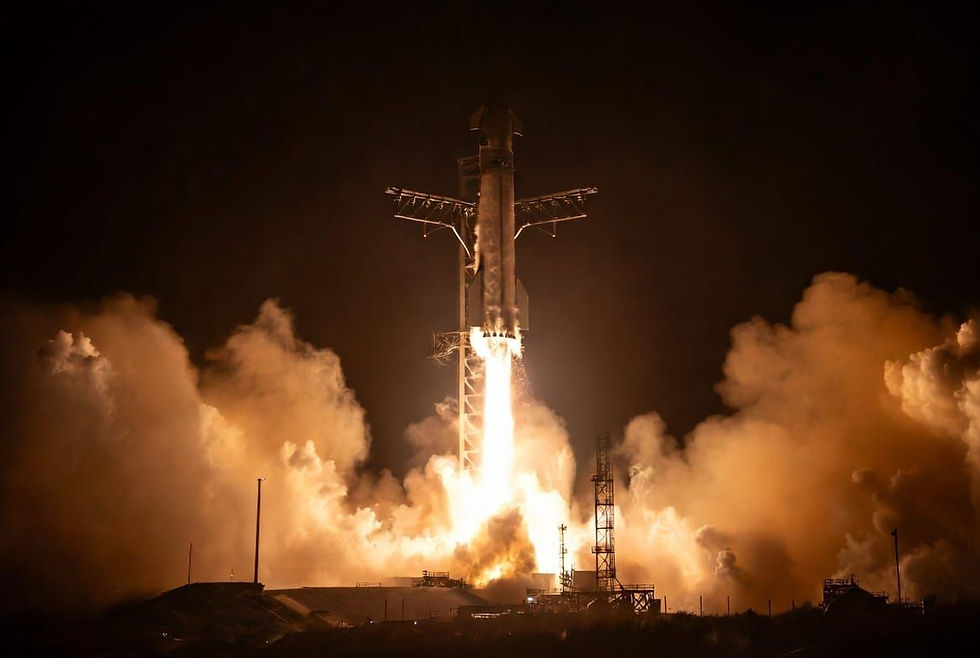
Starship: a generational leap. SpaceX already crushed LEO launch costs from $25,000/kg to ~$2,500/kg via Falcon 9. Starship goes further — both stages fully reusable, powered by Raptor, the first full-flow staged combustion (FFSC) engine ever built. In FFSC, all of the fuel and oxidizer are pre-burned into gas in dedicated turbopumps before reaching the main chamber. This allows more complete combustion of the propellant, delivering higher thrust, better reliability, and true full reusability across both stages. Starship is the most efficient, most performant rocket humanity has ever built: 200+ tons to LEO, targeting below $100/kg.
For context: China's total tonnage to space in 2025 was ~300 tons; global was ~3,000 tons — of which SpaceX delivered 2,500, including 2,100 tons of Starlink alone.
The killer-app problem. Starship is so powerful it risks being economically unjustified without a use case. SpaceX faced this exact problem after Falcon 9; the answer was Starlink (30,000 satellites at 550 km, soon direct-to-cell). One Falcon 9 carries ~25 Starlink sats; one Starship carries ~500. If Starship succeeds, SpaceX runs out of things to launch. It's the iPhone before the App Store — and the killer app is now obvious: space-based AI data centers powered by space solar. Because a single leader drives it across vertically integrated companies, it progresses faster and more coherently than nuclear, wind, or gas.
Why SpaceX needs China — the Tesla precedent. Recall Tesla in 2017: the Model 3 was a product triumph but a production nightmare. American high-volume manufacturing carries a brutal ratio — building a line costs ~5x the annual revenue it generates. China broke the deadlock. Giga Shanghai went from groundbreaking to customer delivery in under a year.
SpaceX faces the same production scaling challenge with solar. To power orbital data centers at meaningful scale, SpaceX needs solar manufacturing capacity at rates the U.S. industrial base cannot deliver alone. The Feb 2026 merger — SpaceX at $1T, xAI at $250B — gives Musk 50%+ control across both companies. With unified authority, he can now pursue the same China manufacturing strategy that rescued Tesla, importing or assembling high-efficiency solar panels at the volume required. If 1 GW is already difficult on Earth, 10 GW and 100 GW are near-impossible without it. xAI has the demand; SpaceX now has both the need and the control to solve it.
The technology roadmap. GaAs multi-junction cells will not be used for mass-scale space solar — current space-grade pricing of $50–100/W makes it uneconomic at volume. The realistic path runs through heterojunction (HJT) silicon in the near term and perovskite-on-HJT tandems later.
HJT silicon already offers ~25–26% efficiency at a fraction of GaAs cost, bringing the target per-watt economics discussed earlier within reach at scale. Perovskite tandems could push efficiency above 30% with dramatically better energy-to-mass performance. Durability under space conditions remains the main open question, with in-orbit validation still early.
Only two Chinese firms currently produce HJT at commercial scale: Risen Energy and Huasun. For Chinese manufacturers, scaling durable HJT is now an engineering and capital problem rather than a fundamental scientific one. Musk-linked teams visited several Chinese solar suppliers earlier in 2026. Given ITAR restrictions on direct imports of finished space-grade panels, the most likely route is importing Chinese manufacturing equipment (such as from Suzhou Maxwell and others) to build capacity domestically, potentially through licensing or joint ventures.
The irony writes itself: China builds chip fabs on Western lithography; the US builds solar fabs on Chinese equipment. The question is not whether this works — it's when and how. The hurdles are political and commercial, not technical. (Recall it was regulation, not physics, that delayed Starship for years under Biden.)
What an Orbital Data Center Actually Looks Like
This is not a gradual extension of today's satellite industry. SpaceX has filed with the FCC to launch over 1.2 million satellites — more than every satellite humanity has ever orbited, combined. They form a three-tier constellation functioning as a single distributed compute fabric:
VLEO (500 km) — 800,000 satellites. The edge layer. ~1,000 TOPS each, ~20 ms latency to ground. Real-time inference.
LEO (1,000 km) — 300,000 satellites. The regional layer. ~5,000 TOPS each. The bulk of training.
MEO (2,000 km) — 118,000 satellites. The cloud layer. ~20,000 TOPS each. Long-running workloads and storage.
Each Starlink V3-derived satellite weighs ~2 tons, and nearly half — ~850 kg — is the compute payload: radiation-hardened silicon, liquid cooling loops, high-efficiency solar power conversion. These aren't comms satellites with compute bolted on. They're flying data centers, with the bus built around the silicon. Compute is a space-rated Dojo 2 variant, 12–24 chips per satellite, stitched together by inter-satellite laser links at 100+ Gbps per link — and in space there’s no practical channel limit, so aggregate throughput climbs into the terabits.
The launch math is what makes it tractable: at 2 tons each, one Starship delivers 50–75 satellites per flight (leaving margin for deployment systems and operational conservatism). On legacy launch systems, the deployment timeline would exceed the satellites’ useful life before the constellation could be completed. With Starship, the full constellation could be deployed in roughly nine years — reaching 10% by year three, 50% by year six, and 100% by year nine.
The critical milestone is 2028: Musk's deadline for Tesla and SpaceX to each deliver 100 GW of annual solar-cell capacity. Even with 100% acceleration, the fastest HJT reaches commercial maturity in ~two years. A 40 MW data center in space could cost as low as $8.2M versus $167M on Earth — the latter saddled with 2–3 years of supply-chain bottlenecks.
The feedback loop. Tesla and SpaceX converge into a unified industrial ecosystem: SpaceX unlocks limitless energy, xAI unlocks intelligence, Optimus executes physically, Tesla chips supply compute. The missing piece was semiconductor fabrication — now being addressed by Tesla's Terafab plans unveiled in March 2026. Close this loop and you reach an age of abundance, an economy measured in output rather than currency. A lunar base is almost certainly necessary intermediate infrastructure — no atmosphere, one-sixth gravity, regolith rich in silicon and aluminum, with electromagnetic mass drivers eventually launching satellites without rockets. SpaceX has accordingly shifted near-term priorities away from Mars toward xAI's space DC buildout.
The solar cost trajectory:
Today’s Chinese cells, lifted to orbit at no cost: ~$0.025/W delivered (a conservative upper bound assuming no further cell improvements).
Mature HJT cells (~$0.06/W on Earth, ultra-thin and rollable) with a 10x space multiplier: ~$0.006/W delivered.
Perovskite tandems have the potential to go significantly lower still.
At a 100 GW/year buildout rate, annual capital expenditure would be roughly $25 billion using today’s cells, ~$6 billion with mature HJT, and as low as ~$600 million with mature perovskite — a more than 40x spread. The solar cell roadmap is not a side detail. It is the central economic lever.
Cooling — the counterintuitive part. Space is cold, but a vacuum has no air or fluid to carry heat away, so chips in orbit cannot cool through convection the way they do on Earth. Terrestrial data centers pay dearly for the air they take for granted — a 1 GW AI cluster draws ~627 MW for the silicon and another ~373 MW (nearly 40%) for cooling, power conversion, and networking. In space the physics inverts: heat can only be rejected by radiating it into the ~3 K background of the universe. The catch is that radiation moves heat far less effectively than convection, so orbital cooling requires large surface area. The architecture is elegant: each satellite is a flat panel, with the sun-facing side generating power and the shaded side radiating waste heat into space. The same geometry that makes generation efficient also makes thermal rejection efficient. Starship lifts power source, radiator, and structure in a single piece of hardware.
Launch frequency. Musk predicts 300–500+ GW/year of space compute deployment within ~five years, with a theoretical 1 TW/year ceiling. 100 GW requires ~5,000–11,000 Starship launches annually — up to one per hour. Each launch consumes ~1,000 tonnes of methane; even at aggressive cadence, gas and LOX demand stays low-single-digit percentages of US production. A lunar factory with mass drivers could ultimately deliver up to 1 PW/year. Tesla's AI5 (Q2 2027) and AI6 (Q2 2028) chips align with this; AI6 is the intended core chip for orbital DCs, and Dojo 3 has been rebuilt around AI6 clusters in a standard NPU style after earlier custom designs proved unscalable.
Communication — fiber optics without the fiber. Optical Inter-Satellite Links (OISLs) are the nervous system. Starlink already runs 9,000+ laser terminals at up to 200 Gbps — the largest coherent optical network ever built. The 1.2M-satellite filing implies 4–8 terminals each, 5–10 million units over nine years — a number that shatters every existing aerospace optical supply chain and forces photonics toward semiconductor-class volume economics.
The hard part was never the lasers — it was the aim. Two satellites can have relative velocities of up to 15 km/s. Even a tightly collimated laser beam still spreads to roughly 20 meters wide after 1,000 km, while the receiver remains a sub-microradian target (an extremely precise angular aiming requirement smaller than one millionth of a radian). Fast-steering mirrors adjust >1,000x/second with predictive software aiming where the target will be. This Pointing, Acquisition, and Tracking (PAT) is why OISLs stayed a lab curiosity for forty years. SpaceX's contribution was industrial, not scientific: building PAT cheaply enough, in large enough numbers, to actually work.
The zero-dispersion advantage shapes the entire supply chain. In vacuum, all wavelengths travel at exactly the same speed, eliminating chromatic dispersion and pulse smearing. Terrestrial fiber requires expensive coherent transceivers to compensate for these effects, whereas space-based links can rely on simple, low-power direct detection. Most inter-satellite links operate over short distances in tight clusters, allowing the majority to use cheap electro-absorption modulated lasers with basic receivers. Only the minority of long-distance vertical links require more sophisticated coherent gear. The implication is significant: shifting incremental AI data centers to space does not automatically expand the photonic market — in some segments it may reduce demand for high-end terrestrial components. We’ll explore this in more detail later.
Lasers offer structural advantages that make space a superior medium for data movement. They support far higher bandwidth than traditional radio systems while also outperforming terrestrial fiber in key respects. Because vacuum has no dispersion or nonlinear effects, high data rates can be achieved with simpler and lower-power components than those required in fiber. Lasers are also inherently more secure: even after natural beam divergence over distance, the spot size remains narrow enough that interception or jamming requires precise positioning within the beam path. In addition, optical spectrum is unlicensed, removing regulatory barriers to dense deployment. Most importantly, light travels through vacuum roughly 47% faster than through fiber, meaningfully reducing latency between compute nodes. In this sense, orbital data centers benefit not only from location but from a physically superior interconnect fabric.
Cluster Geometry: What Most Analysts Get Wrong
Most analyses assume orbital data centers would function as a loose, widely dispersed constellation spread across a large orbital shell. In reality, the architecture is built around tight orbital clusters. Each cluster operates as a self-contained data center, with satellites flying in formation within a relatively small volume — roughly a 100 × 100 mile box. Just as you would not build a large GPU training cluster with nodes scattered across different cities, you would not spread compute satellites thinly across an entire orbital plane.
This has major implications for link distances. Because satellites within the same orbital tier fly in tight formation, most connections between them are relatively short — typically 20–160 km. Unlike traditional satellite constellations, there are no long-distance backbone links spanning thousands of kilometers within the same orbital layer. Instead, the longest connections are the vertical links between different orbital tiers: from VLEO to LEO (roughly 500 km), LEO to MEO (roughly 1,000 km), and VLEO to MEO (up to around 1,500 km), with actual path lengths reaching 500–2,000 km depending on the angle.
The supply chain consequence follows directly: the vast majority of optical terminals by unit count are short-range, low-power, direct-detection links that can use cheap EML transmitters and integrated silicon-photonic receivers. Expensive, high-power coherent terminals — which dominate traditional space laser economics — are only required for the minority of long-distance vertical links between tiers.
A VLEO satellite typically carries 5–7 terminals. It has 1–2 Earth-facing RF phased arrays for the revenue-generating link to ground, since optical links are unreliable through clouds and atmospheric turbulence. It also carries 1–2 higher-cost optical terminals for vertical links to higher orbital tiers, which require the most sophisticated pointing, acquisition, and tracking. The remaining 2–3 terminals are ultra-low-cost optical links for intra-cluster communication, where satellites fly in close formation with near-zero relative velocity, allowing 100 Gbps links with just a few milliwatts of power.
LEO clusters, which handle the bulk of AI training, require 4–6 intra-cluster terminals per satellite to support 400G–1.6T aggregate bandwidth for all-to-all gradient synchronization. MEO, which hosts longer-running workloads and storage, carries the most expensive vertical terminals — typically $5,000–15,000 each, compared to just $50–200 for intra-cluster links.
By unit count, intra-cluster links (20–160 km) in LEO clusters make up roughly 60–70% of all terminals and are the lowest cost. Vertical cross-tier links (500–2,000 km) in MEO account for 15–25% and are the most expensive. Earth-facing RF terminals, used only on VLEO satellites, represent 10–15% and belong to an entirely different technology stack.
The volume-shift framework. The common mistake is viewing the space DC optical market as purely additive. The opposite mistake is assuming it will wholesale replace terrestrial infrastructure. In reality, existing data centers represent trillions in sunk capital and will continue operating. The real substitution occurs at the margin of growth.
Hyperscaler IT load is projected to surge roughly 6x by 2035, requiring over 100 GW of new capacity. Much of this faces severe terrestrial constraints — grid queues, permitting, water, and land availability. Space data centers act as a relief valve. GPUs that would have been racked in Texas will instead sit on satellites, and the optical interconnects that would have used fiber transceivers can instead use free-space laser terminals.
For core photonics components — lasers, modulators, detectors, drivers, and TIAs — much of the demand is therefore migrated rather than newly created. The investment thesis rests on three secondary effects: space-qualification pricing premiums, shifts in product mix, and genuinely new demand categories.
Three new demand categories emerge with no terrestrial equivalent. PAT (Pointing, Acquisition, and Tracking) systems have no ground-based counterpart, creating an opportunity for companies like STM. Free-space optics hardware — including telescopes, coatings, and filters — replaces simple fiber ferrules with far more complex assemblies, benefiting players such as Coherent. Inter-orbit links also represent entirely new demand, as there is no equivalent in terrestrial networks.
At the same time, one category faces structural decline: fiber. With vacuum as the propagation medium, Corning’s hyperscale data center fiber business encounters a long-term headwind. Another category shrinks: coherent DSP complexity. As chromatic dispersion disappears in space, demand for advanced DSP ASICs from companies like Marvell and Broadcom is reduced.
The bandwidth demands of intra-cluster links are dictated by the compute layer, not the transmission medium. Whether a connection spans 2 meters of fiber or 80 km of vacuum, the GPUs still require the same high-speed, low-latency interconnects for all-to-all gradient synchronization. As a result, the intra-cluster optical roadmap in space closely follows the terrestrial trajectory: 1.6T per link expected around 2027–28, scaling to 6.4T by 2030–32, and 12.8T thereafter.
At speeds scaling toward 6.4T and 12.8T per link, the choice of optical technology becomes important. These high aggregate bandwidths can be achieved either by using many lower-speed lanes or by pushing much higher data rates per lane.
At 100 Gbps per lane, silicon photonics combined with advanced CMOS drivers and integrated TIAs is generally sufficient. This is good news for cost, because the highest-volume part of the constellation — the short intra-cluster links — can likely rely on silicon-based solutions. In this regime, MACOM’s InP-based laser drivers and TIAs are less essential, as silicon CMOS can meet the performance requirements.
However, at much higher speeds such as 800 Gbps per lane, the technical demands change significantly. Driving lasers and amplifying received signals at these extreme data rates requires components that can deliver high voltage swings, maintain linearity, and operate efficiently at very high frequencies. Silicon CMOS approaches its physical limits in this regime, while InP-based components — where MACOM has a strong position — offer substantially better speed, linearity, and power efficiency. On a satellite, where power and heat are tightly constrained, this makes InP laser drivers and TIAs a practical necessity for the highest-speed links rather than just a performance upgrade.
At 6.4T per link (using eight 800G lanes), each Space DC terminal requires 16 MACOM InP analog ICs, representing roughly $130–320 of content. At 12.8T (using sixteen 800G lanes), this doubles to 32 ICs and $260–640 per terminal — 5–20x more than the $15–40 typically found in a current 800G terrestrial transceiver. This means MACOM stands to generate significantly higher revenue per terminal in the Space DC architecture than in conventional terrestrial deployments.
This dynamic makes MACOM unique within the volume-shift framework. While most photonics companies face flat or declining content as AI infrastructure migrates from terrestrial to space, MACOM’s content per link increases with each bandwidth generation. Higher speeds drive greater reliance on its InP technology, causing revenue per terminal to scale superlinearly with bandwidth.
This advantage is reinforced by developments on Earth. As the terrestrial industry shifts toward co-packaged optics (CPO), demand for discrete InP laser drivers declines because the driver function is integrated into silicon. However, high-performance TIAs remain difficult to integrate at very high speeds and are needed in greater numbers due to higher bandwidth density per switch ASIC. At the same time, the Space DC opportunity creates a high-content, somewhat captive market: because satellites are severely power-constrained, InP’s efficiency advantage becomes a hard requirement, making substitution with silicon impractical. As a result, MACOM’s space business is expected to more than offset any decline in terrestrial laser driver content, while also benefiting from growing TIA demand on Earth.
The Optical Supply Chain: Winners, Shifts, and Newcomers
Current near-term winners (2026–2029) are those already flying radiation-hardened, vacuum-qualified components. SpaceX doesn't issue open RFPs and wait — heritage is paramount.
MACOM (MTSI) — Top pick. The only company benefiting from all three dynamics: near-term heritage (TIAs and drivers in Mynaric CONDOR and classified programs), superlinear content growth to 6.4T–12.8T, and relevance across both intra-cluster and inter-orbit terminals regardless of who designs the terminal. Its vertically integrated InP fab in Lowell makes it one of only two or three firms globally that can supply III-V analog at 200 Gbaud/lane. Current market pricing doesn't fully reflect future space revenue.
STMicroelectronics (STM) — Hold, reframed as a PAT and power-management play. Every inter-satellite terminal needs a 1,000+ Hz PAT control loop. STM's 28nm FD-SOI is the perfect fit — radiation tolerance without full rad-hard cost, automotive-grade pricing for million-unit constellations. STM loses the analog driver/TIA sockets to MACOM at higher speeds, but the PAT socket is permanent — a chip that doesn't exist on Earth and can't be displaced by any photonic-integration trend.
Coherent (COHR) — Hold. Free-space optics and inter-orbit amplification. Genuinely incremental: precision optics (telescopes, coatings, filters) across all terminals, plus EDFAs for the longest links. End-to-end vertical integration (crystal growth → polishing → coating → assembly) is unmatched. But the EDFA opportunity is narrower than it appears — most intra-cluster links don't need amplification. Real near-term wins, not transformative at corporate scale.
Hamamatsu (6965.T) — Buy. InGaAs APDs for weak-signal links (inter-orbit relays, demanding intra-cluster links at 6.4T+). 70%+ market share from decades of III-V detector R&D competitors can't copy. High content per terminal ($30–80 at 8–16 channels), but the smallest addressable terminal count here. Its NKT Photonics acquisition makes it a credible second EDFA source. Size accordingly.
Lumentum (LITE) — Optionality. Supplies the EML at the heart of every intra-cluster terminal — structurally protected because silicon cannot emit light. But this is largely shifted volume. Benefits from space pricing premiums and inter-orbit demand; the space DC alone doesn't justify a re-rating.
Tower Semiconductor (TSEM) — Buy. SiPh PIC integration platform, winning on radiation tolerance and heritage. Volume largely shifted, but value per PIC rises (absorbing PAT detector arrays and control logic) and the disappearance of coherent DSP complexity improves yield and margin.
Corning (GLW) — Structural loser. Fiber demand declines as compute migrates from fiber-intensive terrestrial DCs to zero-fiber orbital ones. Not a short — 5G and FTTH provide other drivers — but the exponential-AI-fiber narrative weakens materially.
Inter-orbit communication — the one truly new market. Unlike intra-cluster and vertical links, inter-orbit communication has no terrestrial equivalent and therefore generates purely incremental demand for the photonic supply chain.
In a terrestrial data center, the edge, training, and storage tiers sit close together and are connected by fiber over short distances. In the Space DC, these tiers sit at different orbital altitudes, separated by hundreds to thousands of kilometers. Rather than attempting direct long-distance laser links between tiers, the architecture uses Starlink satellites as relay nodes. A VLEO satellite links to a nearby Starlink satellite, which routes traffic through the mesh to another Starlink satellite near the target tier, keeping each individual hop under roughly 1,000 km.
This relay architecture creates demand for additional high-performance optical terminals on Starlink satellites that did not previously exist. A next-generation relay satellite may need 6–8 terminals operating at 1.6T–6.4T each to handle inter-tier traffic such as gradient updates, model weights, and inference routing. If the Space DC generates 100 Pbps of inter-tier traffic, roughly 15,000 relay terminals would need to operate simultaneously, implying 50,000–100,000 deployed terminals across the constellation. At $2,000–10,000 of photonic content per terminal, this represents a $100 million–$1 billion cumulative opportunity — moderate in absolute scale but 100% incremental, with non-displaceable content for every major supplier.
The newcomer thesis — and this is the part to internalize. The companies best positioned for 2030–2035 may not be today’s space-laser incumbents. A Mynaric CONDOR Mk3 delivers roughly 100 Gbps in a 30 kg package costing around $500,000 — the wrong product for a space data center that needs 6.4T–12.8T in a sub-5 kg terminal at well under $5,000. Meanwhile, terrestrial AI is already solving the core problem at data-center scale and economics. Companies such as Ayar Labs, Celestial AI, Lightmatter, and Ranovus are building high-bandwidth photonic interconnects optimized for the cost, power, and density requirements of large AI clusters. If compute moves to orbit, their technology can move with it — the main additions required are radiation tolerance and a free-space optical front end with pointing, acquisition, and tracking. The architectural DNA flows from the data center to space, not the other way around. Incumbents are well placed to capture the early phase when volumes are low and heritage matters, but the market is likely to transition toward high-volume photonic integration players as scale increases. Do not extrapolate incumbents’ early heritage advantage into a durable long-term moat.
Tower Semiconductor: The SiPh Foundry for the Space DC
Tower operates what is arguably the most important foundry platform in silicon photonics. Its PH18 process has become the de facto manufacturing standard, with Ayar Labs, Lightmatter, and Ranovus all building their ecosystems around it. The lock-in is structural: unlike digital CMOS, where logic can be resynthesized onto a new process node, photonics has no abstraction layer. Every optical element’s performance is defined by precise physical geometry, so switching foundries requires a full redesign from scratch.
GlobalFoundries positioned its 300mm Fotonix platform as a competitive alternative, citing 2.25x more die per wafer. However, the ramp has been slow, the PDK remains thinner, and the wafer-size advantage is inherently weaker in photonics. Waveguides cannot be scaled down like transistors because light has a fixed wavelength of roughly 1–2 μm. Advanced lithography improves dimensional control, but it delivers only incremental gains rather than the step-function economics seen in digital nodes.
At OFC 2026, Tower effectively closed the competitive argument by announcing a SiGe BiCMOS + Silicon Photonics platform on full 300mm wafers. Tower now matches GlobalFoundries on wafer format while retaining clear advantages in ecosystem maturity, customer lock-in, and process heritage. In the space context, the gap is even wider: Tower has published radiation performance data (total ionizing dose, single-event latchup, and proton irradiation), while GlobalFoundries has published essentially none for Fotonix. GlobalFoundries should be removed from the Space DC supply chain thesis.
Tower’s new SBC18H6 node delivers Ft/Fmax of 325–450 GHz, enabling stable 112 Gbaud PAM4 — the threshold required for 1.6T and 3.2T links. Critically, it reverses silicon photonics’ traditional power disadvantage. Where SiPho previously consumed over 30% more power than InP EMLs, the new platform is now approximately 30% more power efficient. The SiGe die is hybrid-bonded directly atop the photonic die in 3D, with low-parasitic interconnects that narrow the integration gap with monolithic InP — not by matching InP’s material advantages, but through superior packaging.
The manufacturing economics are transformative: 300mm silicon wafers, yields above 85% (versus 40–60% on InP specialty nodes limited to 100mm wafers), and roughly one-third the cost of equivalent InP solutions. This represents a structural cost reset rather than an incremental improvement.
Tower controls an estimated 80%+ share of high-end SiGe BiCMOS capacity and has already contracted the majority of its output to Broadcom and Marvell through 2028. It is investing over $900 million to expand capacity by approximately 5x. With SiPho penetration at 800G expected to exceed 85% by 2028, and 400G-per-lane becoming a requirement for SpaceX’s large-scale deployment in 2028–2030, Tower’s combination of high frequency performance, low power, high integration, low cost, and mass-production scalability positions it as the default architecture. InP EML remains short on frequency and high on cost, while TFLN remains unproven for space environments. Tower is the silicon photonics foundry for the Space DC.
The Financials: Where Valuation Meets Physics
SPCX fundamentals. 2025 revenue: $18.7B, up 33%. Starlink contributed $11.4B (61%) and is the profit engine. Adjusted EBITDA: $6.6B; GAAP net loss: $4.9B (driven by aggressive AI, Starship, and orbital capex). At ~$2.4T market cap against ~$30B NTM revenue, the implied forward P/S is ~80x — elevated, but the core business already generates substantial adjusted profit. The IPO wasn't needed to fund operations; it raised $75B as dry powder for the capex ahead. Segments: Starlink $11.4B (61%), Launch $4.1B (22%), AI $3.2B (17%) — the AI segment absorbed ~$12.7B in capex.
ROI of the terrestrial DC (TDC) business. Q1 2026 AI capex hit $7.7B — a $30.9B annualized run rate. xAI's infrastructure team executes exceptionally (first 60k H100s in ~120 days), though model training lags — Grok sits firmly tier-1 but a step behind the tier-0 frontier set by Mythos, partly because xAI's high-pressure, rapid-iteration culture is less optimal for frontier research than the deliberate cultures at Anthropic.
While SPCX front-loaded capacity, most hyperscalers underbuilt — creating excess SPCX capacity Musk monetized via three-year deals with Google ($30B) and Anthropic ($45B): $75B contracted against ~$20B capex, or $25.8B/year. Anthropic's ARR exploded from $9B to $40B by Q1 2026; Google sold 2M TPUs to Anthropic before realizing its own teams lacked compute (Gemini now at 9M MAU). The Convequity AI Bubble Barometer shows hyperscaler forward ROIC on AI capex at ~32%. H100 hourly rates have spiked again this year — remarkable for a three-year-old chip.
The root cause is an industry-wide bottleneck: TSMC limiting logic and CoWoS (mild); DRAM/HBM/NAND (large and growing); EML/InP lasers (large); and most importantly power — 40 of 100 AI DC projects cancelled for lack of secured power. Regulatory friction is the biggest hurdle, then power access. Gas can't serve 10 GW → 100 GW; ground solar technically can but tariffs block panel imports. This is precisely why space DC (SDC) becomes the bottleneck-solver: no regulatory friction, falling payload costs.
Space DC economics. With fully reusable Starship V3: 100 GW needs ~10,000 launches at ~$5M each = $50B, or $500M/GW for launch. Solar at aggressive $0.20/W adds ~$200M/GW.
We model first-gen AI1 on a Starlink V3 chassis: 150 kW, NVL72-like rack, non-rack components ~$500–700k/satellite. At 0.15 MW/satellite, that's 6,667 satellites/GW (using the $500k lower end) → ~$3.3B/GW non-AI-chip cost. Against ~$20B/GW for terrestrial non-IT plus $1B+ annual opex, these look remarkably cheap.

Under conservative assumptions, IT hardware accounts for roughly 80% of the total cost per GW in a space data center, compared to about 60% in a terrestrial facility. This shift occurs largely because the architecture relies on merchant NVIDIA GPUs, which carry very high gross margins of 75–80%. As a result, the computing hardware itself becomes the dominant cost driver.
If Tesla successfully delivers its own space-optimized ASICs on schedule at an estimated $10,000 per kW ($10 billion per GW), the overall cost per GW of space data center capacity would fall significantly — roughly halving to around $16.5 billion per GW.

To cut further you need your own fab — memory makers now run ~80% gross margins on HBM, the largest cost component in high-end accelerators. A Rubin-class GPU's 288 GB of HBM4 at $55/GB = $15,840 in memory alone, dwarfing the $1,500–2,000 compute dies. Vertical integration could bring an AI ASIC to $3,000–4,000 per chip.
With a custom fab halving chip cost ($5B/GW), total 1 GW cost drops to $11.6B.

TerraFabs (announced March 2026) represent Musk’s push to vertically integrate advanced chip manufacturing at unprecedented scale. The long-term target is 1 TW of annual production — more than all existing global fab capacity combined, with roughly 80% intended for space deployment. Even under conservative assumptions, the initial phase could support on the order of 100 GW of compute, aligning with SpaceX’s broader deployment plans.
This is classic Musk: set an extraordinarily ambitious goal where even partial success creates enormous value. The strategic intent is to collapse the traditional fabless → foundry → OSAT cycle into a single, tightly integrated operation, enabling much faster iteration. Reports suggest the program may draw on process IP or technology from Intel, which is reportedly cash-strapped and seeking both a major customer and a way to offset development costs. Musk has reportedly passed on Samsung’s leading-edge node, possibly because he already has access to it at highly favorable terms.
Execution challenges remain significant. The program relies on unproven innovations such as 450mm square wafers and large-scale deployment of High-NA EUV tools, both of which involve long lead times and technical risk. Memory supply is another constraint, as major players have limited incentive to license advanced processes. Despite these hurdles, the core thesis is that even a meaningfully scaled TerraFab capability would structurally lower the cost and accelerate the deployment of custom space ASICs — a critical enabler for the broader Space DC economics.
Valuation & Modelling the SDC Business. The pre-IPO SOTP pointed to ~$1.75T; the IPO priced there. The market now implies $2.0–2.4T.
A 1 GW SDC site approaches $20B/year revenue (versus ~$10–15B for a 1 GW TDC, because SDC over-provisions power by just 5–7%, supporting 900 MW+ of compute versus ~660 MW terrestrially). Baseline: 7-year life, 5% revenue decay for three years then 15%, $20B first-year revenue, $33B/GW capex (conservative — ignoring up-to-10x solar cost cuts), $250/kg payload (the high bar), 10% WACC.

This yields ~$50B in added market cap per GW deployed, cross-checking against a 50% IRR — not unreasonable given TDC's 30%+ ROIC. Upside levers: selling models (not just raw compute) if xAI reaches SOTA, and custom ASICs, which lift the figure to $64B/GW.
The trillion-dollar question: how many GW per year? Launch ceases to be the constraint after Year 4 (2029, possibly 2028). The next bottleneck is solar manufacturing.

A combined 200 GW of solar-panel capacity from Tesla and SPCX is clearly a frothy number, given how hard it is to manufacture solar cells in the U.S. at low cost and on time. Direct access to Chinese equipment, production lines, engineers, and know-how would make a 2028 timeline far more achievable — but whether Beijing permits it is an open question. Even assuming SPCX achieves just 10% of 200 GW — 20 GW per year — that still implies nearly $1 trillion in market cap added annually.
Orbital real estate adds a modest constraint: AI1's dawn-dusk sun-synchronous shell (600–800 km) supports only ~1 GW given 4 km minimum separation, so SPCX will need additional orbits — some with slightly lower solar efficiency but higher density.
Path to $20 Trillion. Musk has indicated that SpaceX can deliver a 10x return. Only substantial success in the Space Data Center (SDC) business can realistically achieve that scale. Reports suggest Musk has already secured roughly 20% of NVIDIA’s upcoming Rubin production — around 1 million GPUs — underscoring the seriousness of the bet.
Reaching a $20 trillion market cap at a 15x P/E would require approximately $1.33 trillion in annual profit. Assuming 30% operating margins on the SDC business, this implies roughly $4.43 trillion in revenue. At $20 billion of revenue per GW of deployed capacity, around 222 GW of space compute would be needed. This figure could be lower if high-margin applications (such as Cursor) are layered on top of the raw infrastructure, increasing average revenue per GW.
If both Tesla and SpaceX can each deploy on the order of 100 GW per year, this level of capacity becomes achievable within a little over two years under optimistic assumptions.
An alternative, more conservative framing assumes that Starlink, Launch, and Cursor together are worth around $2 trillion. In this scenario, the SDC business would need to deliver nearly the entire remaining $18 trillion of value on its own. Using a more conservative revenue assumption of roughly $11 billion per GW — effectively treating SDC as pure infrastructure without significant contribution from application-layer margins — the required deployed capacity rises to approximately 360 GW, or about 36 GW per year over a decade.
While ambitious, this remains plausible when viewed alongside other strategic levers, including custom silicon, TerraFabs, in-house solar manufacturing, and AI model economics. The path to $20 trillion appears credible even if only some of these factors deliver meaningful results.
Cursor. SPCX agreed to acquire Cursor for $60B — a bargain even before synergies (revenue heading to $6–10B by year-end). Written off by many after Claude Code overtook it, the Cursor team proved highly agile, post-training open-source models (DeepSeek, Kimi) into its own Composer — now holding some of the best coding-model RL know-how outside the major labs (Composer 2.5 on Kimi 2.5 is the signal). The bigger prize: accelerating Grok to catch Claude Code and Codex on both foundation capability and agent harness.
The DCF. A standard DCF misses the nuance, so we built a Special View (Base/Bear/Bull scenarios feeding a revenue path) linkable to the DCF View — available in the SpaceX Valuation Model for subscribers.


The valuation range for SPCX is extraordinarily wide and depends almost entirely on execution in the Space Data Center business. Under the base case — assuming around 60 GW of annual solar deployment within a decade and solid long-term margins — the model points to very substantial upside from current levels, with 2040 revenue reaching several trillion dollars.
In a more optimistic scenario with significantly faster solar scale-up (approaching 200 GW within ten years), the valuation becomes extremely large. While the precise output relies on a chain of aggressive assumptions, the asymmetry highlights the magnitude of the opportunity if SpaceX executes at the upper end of its ambitions.
Even under more conservative assumptions — slower Starship cadence and more limited SDC adoption — the model still shows meaningful upside, suggesting the investment case remains attractive even with tempered expectations.
Current sell-side consensus implies roughly $160 billion in revenue by 2028. After backing out Starlink, Launch, and Cursor (estimated at around $30 billion combined), the Space DC business would need to contribute only about $130 billion — equivalent to roughly 6 GW of deployed capacity at prevailing revenue-per-GW assumptions. This level appears achievable even through terrestrial data center deployments alone in the early years.
The Bottom Line
SPCX is the ultimate AI data-center and energy play, with optionality in coding agents and foundation models on top. Its sustainable long-term profitability hinges on one unique capability: delivering AI infrastructure while everyone else faces mounting bottlenecks in regulatory approval, power, and chips.
There is no doubt they can deliver Starship V3 and successors. There is no doubt they can make space DC satellites work. The binding constraint is ultimately semiconductor manufacturing and design — Musk will need to go deep into logic and memory foundry, 224G SerDes and beyond, or partner with Broadcom or Nvidia.
The AI energy crisis is not merely a constraint on data-center growth — it is a forcing function for the next energy revolution. Terrestrial solutions, nuclear or renewable, face fundamental limits of scale, timeline, or geography. Space solar, enabled by Starship's dramatic cost reduction, offers a path to genuine energy abundance.
Within a decade, the largest AI training clusters may operate in orbit: powered by sunlight unfiltered by atmosphere, cooled by the infinite heat sink of space, connected via laser links, unconstrained by the finite capacity of terrestrial grids. The infrastructure we build in the next five years will determine the possibilities of the decades that follow.
This is marketing material for NewDeal Invest. The investment style is aimed at investors with a high risk profile and a long-term investment horizon, and past performance is no guarantee of future returns. The stocks that NewDeal Invest invests in are more volatile than the broader stock market, and therefore fluctuate more both up and down. NewDeal Invest does not provide investment advice, and all investment decisions are made by you yourself. No information from NewDeal Invest should be considered a recommendation. Short-term investments, with a time horizon of 5 years or less, are discouraged both in NewDeal Invest, PMINDI, and in the stocks mentioned. See relevant risk factors at https://newdealinvest.dk/ and https://newdealinvest.dk/pmindi/

Kommentarer